
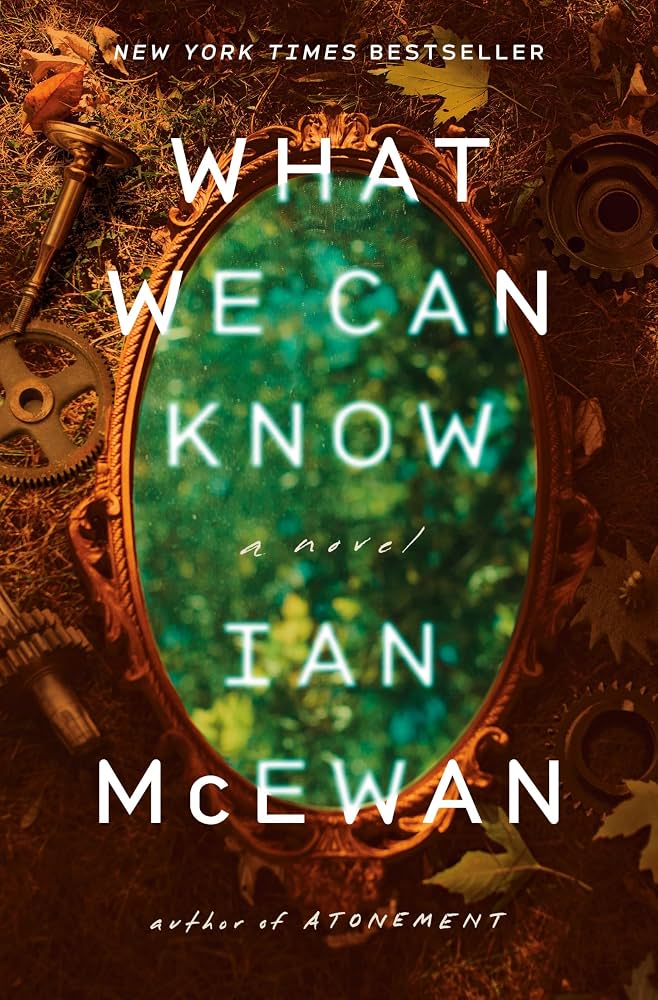
Ian McEwan’s What We Can Know (Alfred A. Knopf / Penguin Random House, 2025) is my second recommendation for the feminist historical theology summer reading list. You can see my first recommendation, my review of Hayley Gelfuso’s The Book of Lost Hours and the introductory explanation to this post series (in which I explain what I mean by feminist historical theology) here. While I haven’t yet read the book, in the same vein, I would also recommend reading Carolyn’s review of Yesteryear by Caro Claire Burke. However, I highly recommend What We Can Know. I started recommending this book before I even finished it and bought copies for several of my friends and my dad as gifts because I liked this book that much.
The book itself is divided into two parts. The first part is the story of Thomas Metcalfe, a literature professor in 2119, as he researches the events of what has become known as the “Second Immortal Dinner” and a lost poem, by fictional poet Francis Blundy, titled “A Corona for Vivien.” This Second Immortal Dinner occurred in 2014—as Metcalfe is a specialist in the literature of the years 1990–2030—and only one copy of the poem was created and given by Blundy to his wife, Vivien.
The first part of the novel is the discussion of the research and teaching that Metcalfe does, and his relationship with historian, Rose Church, with whom he teaches an interdisciplinary seminar on their period of specialization. Metcalfe’s goal is to find the text of the “Corona for Viven,” spending time in the remaining accessible archives to see if he can find any hints about what might have happened to it, and attempting to reconstruct the events of that night and what followed. The second part of the book is the text of a manuscript from the period. Because of this, I highly recommend reading this book twice (as I did, listening to the audiobook the first time and then reading a physical copy in preparation for writing this post). So much more stood out to me on the second read, once I knew the ending.
Now, I will do my best in this post not to spoil too much but just be warned that there may be spoilers ahead.

Part of the reason that Metcalfe can only access certain archives is that the world Metcalfe and Church live in is, quite literally, much smaller than our world. In 2042, what is known as the “Inundation” occurred—this was a nuclear strike from Russa against the “West,” which crashed into the Atlantic and “hurled seventy-metre-high waves towards Europe, West Africa and North America” (p. 105). This caused massive population loss, as well as the loss of much of the land on the coasts in the war that followed. The result as Metcalfe described it? “More than 200 million died. Britain became an archipelago, its population halved. However, none of the twenty-first century’s nuclear exchanges led to total war and humanity’s extinction. There was our morsel of consolation. We were not so irrational after all” (p. 106).
One of the things that I love about this book is the way that McEwan tells the story. It is all told from Metcalfe’s point of view, and he will be going on about his research, only to abruptly shift to give hints about what happened to get us from the time that we live now to the somewhat post-apocalyptic world that Metcalfe lives in. He comments, for example, that “Some historians have marked the beginning of the new dark age with the Russian invasion of Ukraine in 2022, and that is where quite a few history books begin or end. I would propose the first climate war in 2036, one in a sequence between two nuclear states, India and Pakistan, traditional enemies. One issue was water, once plentiful in the form of Himalayan glacier-fed ice-melt. Now, as long predicted, drying up” (p. 103). Of course, as with so many of the conflicts that he describes in this section, the countries, “prompted by hair-trigger artificial intelligence choosing the pre-emptive option, missiles were launched, two from each side” (p. 104). Similarly, when Saudi Arabia and Israel attack Iran, “Again, AI on both sides, hungrily and blindly seeking advantage, decided that attack was the best form of defence” (p. 104). There is a lot in this story that is a commentary and a critique on how we are today.
In some ways, given the destruction of these wars, one might think that the information that Metcalfe has access to would be very limited. However, given the time period that he is researching, that is manifestly not so. As Metcalfe describes it, “But so much information, in countless strata of unimportant detail, has survived. It could bury us. Many scholars have suffocated under the weight of trivial facts” (p. 13). All of the digital records are available. He mentions photos, films, recordings, newspapers, magazines, social media, email, etc. He also has access to letters and journals. As Metcalfe comments, “Scholars see, hear and know more of them, of their private thoughts, than we do of our closest friends” (p. 17). However, despite that, “there are obvious limits to our understanding” (p. 17).
It is this idea of the limits to our understanding that I found so fascinating because it connects so well with my feminist historical theology project. The writing that I am currently doing argues for the importance of recovering women’s voices as theological sources. Unfortunately, sometimes the sources that we have—in contrast to Metcalfe—are very limited. As Pope John Paul II recognized in his 1995 Letter to Women:
Yes, it is time to examine the past with courage, to assign responsibility where it is due in a review of the long history of humanity. Women have contributed to that history as much as men and, more often than not, they did so in much more difficult conditions. I think particularly of those women who loved culture and art, and devoted their lives to them in spite of the fact that they were frequently at a disadvantage from the start, excluded from equal educational opportunities, underestimated, ignored and not given credit for their intellectual contributions. Sadly, very little of women’s achievements in history can be registered by the science of history. But even though time may have buried the documentary evidence of those achievements, their beneficent influence can be felt as a force which has shaped the lives of successive generations, right up to our own. To this great, immense feminine “tradition” humanity owes a debt which can never be repaid.
John Paul II, Letter to Women, 1995, sec. 3
What is interesting about Metcalfe’s project, and McEwan’s novel as a whole, is that it highlights in contrast that even though we might have a lot of information about a subject in history, there is ultimately a gap between what we know and what we can assume. Metcalfe, in recounting the night of the Second Immortal Dinner, repeats over and over phrases like “we can assume,” “it is likely,” saying that things “probably” or “may have” happened in certain ways. He recognizes that there is a certain point in which he is inventing the narrative, “but always within the bounds of the highly probable” (p. 26). Whether or not he should do this is, in fact, a debate that he has with Rose (p. 60).
In my research, I’m drawing on the work of Elisabeth Schüssler Fiorenza (In Memory of Her, Crossroad, 1994) and Elizabeth Johnson (Friends of God and Prophets, Continuum, 1998), both of whom argue for a role for historical imagination, which would allow us to reconstruct the silences of the text. This idea of historical imagination is founded theologically in the writings of Thomas Aquinas and Ignatius of Loyola, as a faculty that allows us to construct ideas in our mind based on the input of the senses (see Thomas Aquinas, Summa Theologica I.48.4; Ignatius of Loyola, The Spiritual Exercises). In this case, we can extrapolate from the text to fill in the historical silences based on what we know about the figures we are studying and their time periods.
As I was rereading McEwan’s book, I was also going through and translating some notes from Louis Cognet’s La réforme de Port-Royal, 1591-1618 (Éditions Sulliver, 1950). The phrasing that Metcalfe uses in trying to reconstruct the Second Immortal dinner is very similar to the language that Cogent used in his reconstruction of the early life at Port-Royal under the influence of Mother Angélique’s reform. For example, in discussing the early spiritual directors that she spoke to after her conversion, he wrote (note: this is my very literal translation based on my notes):
It is probable that [it was] their presence which gave to this reform of Port-Royal its very pronounced character. By their discussions as by their letters, many detailed programs were specified, by which the abbey took its own appearance. And it was to them also without contradicting that Mother Angélique, Mother Agnès and the other nuns continue this profound culture—spiritual, even theological—that we will find in diverse degrees in the texts that came from their pens. It is certain that the influence of these first directors was considerable, and that these years had a decisive importance that [some] have sometimes failed to understand.
Cognet, La réforme de Port-Royal, p. 142–3
Now, despite Cognet’s recognition that Mother Angélique and the other nuns “continued” the spiritual—even theological—culture that comes from these early directors, I do have to quibble over the implicit tone of this phrasing. That is, it puts the women in a passive position, which—given the role of the abbess in the convent—we could equally assume did not happen. That said, I was drawn in this passage to the idea that “it is probable” that these early directors gave a pronounced character to Mother Angélique’s reform of the convent and “it is certain” that they had considerable influence.
I’ve also recently started reading Data Empire (HarperCollins, 2026), by my very good friend, Roopika Risam. This one is another one that I would highly recommend. What she does in each chapter is begin with a story that sets the stage for the data collection that will be discussed in the remainder of the chapter. For example, at the beginning of chapter 1, “The First Accountants, c. 9000–1700 BCE,” she reconstructs the story of Sargon. She writes:
The priestess hurried out of the temple with the baby she had delivered in secret. As a servant of Inanna, goddess of love, she could not raise children. Discovery would mean exile. Her basket was rushed, its reeds hastily woven and lid slick with tar, but she lowered it into the Euphrates, hoping the gods would pick up where she left off.
Risam, Data Empire, p. 13
Downstream, a laborer in the kings’ household was walking to the riverbank when he spotted a strange bundle snagged in the reeds. Akki waded in, pulled it to shore, and opened the lid to find a mewling infant. He asked around, yet no one claimed the foundling. For a moment, he considered returning the boy to the water—simple, if final. Instead, he took him home.
I’m texting with Risam as I am writing this post and she affirmed that these stories are exactly what I assumed—a reconstruction of the lives of the figures she writes about, based, of course, in archival and textual materials. This particular story comes from an Akkadian myth, of which Sargon himself may have been the original source, one which, of course, also parallels the story of Moses. Risam is not inventing the stories out of thin air, but using the information provided in texts and archives to fill in the holes about what these historical figures may have been thinking. She has not yet read What We Can Know (I’m sending her a copy for her birthday), but I’m struck by how much Metcalfe’s reconstruction of the Second Immortal Dinner echoes these stories that she includes at the beginning of each chapter. In the first chapter, McEwan has Metcalfe explain:
One early afternoon in October 2014, ‘with a strong wind roaring in a tree beyond my window’, Vivien Blundy was in her study, which was in a converted old dairy separate from the Barn. She was probably making a shopping list of ingredients for the meal she would cook the following day to celebrate her birthday. She would serve the dishes at a gathering to which eight friends had been invited. She would have already devised the placement. Later in the evening they would listen to her husband read a long new poem, which was to be her present. The shopping and cooking were not acts of self-effacement. Vivien had a generous nature, and she liked to please. She enjoyed producing a well-turned meal.
What We Can Know, p. 4–5
Given that Metcalfe is recounting this while he is in the archive at the “Bodleian Snowdonia Library” with Vivian Blundy’s journals open in front of him, you can see how he is taking what she wrote—that there was “a strong wind roaring in a tree beyond my window”—and how he extrapolates from the materials about her personality to assume a probable narrative of the events of that day.
Of course, What We Can Know, is ultimately about the limits to our knowledge and the gap between what we can extrapolate from the sources and what actually happened. I highly recommend this for anyone interested in aspects of history and what we can know from the sources.
My WIT colleague, Carolyn, has informed me that this is the 700th post on Women in Theology! I encourage you all to check out the archives to see how we have grown and changed over the years.

Leave a Reply