
During the academic year, I tend towards audiobooks for works of fiction or nonfiction books that I wouldn’t have time to read alongside my research. This past year, I listened to two books that I loved so much that I am rereading them over the summer—now that I have time—in physical form so I can properly absorb everything that they have. I especially connected to these books as a feminist historical theologian because they have an underlying theme of recovering the ideas of those whose voices are difficult to find in the historical record.
I previously wrote a series of posts reflecting on the methods of feminist historical theology, the first of which reflected on the difficulty of recovering especially women’s voices from history, through the lens of the musical Hamilton. In my second post in that series, I have an early attempt at defining what it means to do feminist historical theology, referencing the work of Elizabeth Johnson in her Friends of God and Prophets: A Feminist Theological Reading of the Communion of Saints (Continuum, 1998). I described feminist historical theology as:
approaching historical sources with a feminist and theological mindset. A feminist mindset means is that when looking at sources, you are reading them through the lens of what they say for women’s liberation. A theological mindset means that you are reading sources both for what they tell us about God and the human relationship to God and for their relevance to the church of today. The issue, of course, remains in how to look at the sources because both the record and history of interpretation of women’s theological traditions (in Johnson’s focus: of women’s images of holiness) are distorted by a patriarchal point of view (Johnson, p. 27–28). Emphasizing the theological part of the project, Johnson argues that this deprives women of a sense of holiness in their own lives, which is why it is so important to recover these women as models (Johnson, p. 29). Or, as I argued in my 2016 dissertation on Angélique Arnauld, we need to recover the models of these women as theologians, not just spiritual writers.
While my published academic work since then has continued to refine this methodology, that still serves as a good overall description of what I mean by feminist historical theology: that is, the importance of recovering women’s voices as serious theological contributions to the history of Christianity, and ones that we should take more seriously if we are to fully understanding theology—in the sense of the understanding of God and the nature of the human person, especially in relation to God. The two books that I am rereading this summer both contribute to the question of the knowability of women’s (and other marginalized) voices throughout history.
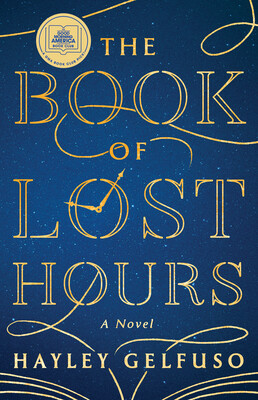
I j just finished rereading the first of these two books, Hayley Gelfuso’s The Book of Lost Hours (Atria Books / Simon & Schuster, 2025). If you follow that link, the description focuses on the three main characters: Lisavet Levy—an eleven-year-old Jewish girl who, at the start of the book, gets thrust into what is called the “time space” by her father, just before Kristallnacht. This saves her life, but she is both stuck and (more or less) alone in this space for many years before she meets Ernest Duquesne, an agent working for America’s Temporal Reconnaissance Program (TRP)—an organization that both spies on other nations who have access to the time space and culls the memories that are stored there, so that those deemed dangerous might not be allowed to spread (they claim to be preventing another WWII). The story flips back and forth between this earlier time and 1965 when Amelia Duquesne, the niece of Ernest, is found by the then-head of the TRP, Moira Donnelly, at her uncle’s funeral. Moira wants Amelia to go into the time space to find a specific book of memories that her uncle was supposedly seeking.
Now, the summary that I just provided is basically what the book description on that link provides. Thus, before reading further, I need to warn you that spoilers will appear. If you don’t want to know what will happen until you’ve read the book, I recommend that you stop reading this post until you’ve had an opportunity to read and then coming back to the post to see if you agree with my analysis later.

The theme of memories that are lost to time, like so many of the stories of women in history, is introduced very early in the book. Lisavet, while stuck in the time space, meets a ghostly figure. This figure does not even know his name anymore, so she names him Azrael. Lisavet asks Azrael if she could see his book of memories and he sadly tells her, “I would if I could; however, I don’t have a book myself. Any specter you see in the time space has not been ‘collected’ so to speak, by a timekeeper. Meaning we have no book of memories to confine us” (p. 16). Thus, by creating this space, the timekeepers have already deemed whose memories are worth saving. While Azrael is the only specter that they interact with in the story, there are others in the time space whose memories have not been deemed worthy of collection. This, of course, is one of the major problems facing the feminist historical theologian—some of the voices of women have not been saved by the “timekeepers” of our world, whether because they were deemed dangerous or just unimportant. As Elizabeth Johnson notes in her work, arguing for a more expansive idea of the communion of saints, “While some few are remembered by name, it enfolds millions upon anonymous millions of people whom we will never know” (Johnson, p. 233).
However, the question of memories becomes important to Lisavet because she witnesses an attempt to destroy the memory of her father.
She watched in horror as the solider [a Nazi] opened the book and withdrew a pack of matches from his pocket. He held the flame to one of the pages until it caught fire. As the flames grew, he dropped the book to the ground, cover face up, spine bent.
The Book of Lost Hours, p. 17
“Timekeepers destroy the memories they don’t want the world to remember.”
Lisavet jumped. Azrael had caught up to her and was watching the scene over her shoulder, his expression grave.
“But why?” she asked.
Azrael shrugged. “To uphold their ideology. The past is a mirror of us. It tells us who we’ve been and what we have become. Some people don’t like what they see in their reflection, so they change it by erasing memories from the face of the earth. By erasing people from existence.”
This is what starts Lisavet’s mission to save memories. She puts herself at risk, trying to save the books from being burned. First from Nazis, then from others—English, French, Americans, Russians, etc. But her hope is to keep the memories of people, and the people themselves, alive. Azrael shows her how to visit people’s memories, and she starts to notice the changes that happen as memories are burned in the time space. “Sometimes the change was subtle. A name once mentioned, glossed over. A face in a crowd erased, the space around them empty and unacknowledged. Other times, the changes were more noticeable. Entire events gone. Lives altered, memories and timelines manipulated to fill in the gaps left by someone who had been erased” (p. 48). While she began saving the memories because the Nazis tried to burn the memories of her father, she starts saving the memories of anyone just because they are memories. This is how she meets Ernest—she is saving the memories of an American and he asks her why she would be interested in saving those memories in particular.
Ernest squinted at her. “What does a German girl want with the memories of an American?”
The Book of Lost Hours, p. 57
“I didn’t know they belonged to an American,” Lisavet said, mirroring his body language.
“Then why did you save them?”
“Because they’re memories.”
“So?”
“So they were worth saving.”
This begins a relationship between Ernest and Lisavet, in which she starts to convince him of the importance of saving memories just because they are people’s memories.
“When I first started saving memories, I was mostly taking them from the Nazis. That’s what’s in the first half of the book. I’ve walked through all of them hundreds of times to see why someone might want to destroy these memories, but I can’t. So little of what the timekeepers are destroying is anything dangerous. Little moments. Tiny conversations. Civilian lives that contradicted what the Nazi Party was trying to do. It made me think … if even simple memories are so important that someone would try to destroy them … then maybe wasting any of them is a mistake. Maybe they’re actually the most precious thing we have. And besides. What gives someone the right to decide what stays?”
The Book of Lost Hours, p. 94
“History is written by the victors,” Ernest quoted, just loud enough for Lisavet to hear him.
She turned her eyes on him. Not angry, but close to it. “You say that now. But what happens if one day someone else wins? What if they decide to erase your father’s memories? Like they tried to erase mine?”
“I suppose I wouldn’t like it.”
Lisavet bit her lip, head shaking. “But that’s just it. You wouldn’t even know it had happened. Your life would rearrange itself around his memory.”
The timekeepers (read: historians, historical theologians) of today have a responsibility to the past because people cannot know about this history unless we tell it. As Lisavet notes, “You wouldn’t even know it had happened,” unless someone deemed the memory important enough to save.
It was conversations such as these in the first half or so of the book that really struck me as I was reading. This book is very much an engagement with the project of history, through the lens of the timekeepers and their ability to keep or destroy the memories that we have, thus changing what we remember and what we forget about our own histories. It also references the inability of historians to truly know the past—“People don’t remember things the same way. Is it even possible for us to remember something as it truly happened? A memory, once it’s over, is never exactly what it was when it was happening. Whatever comes later changes the meaning of it,” (p. 93) Lisavet explains at one point.
In influencing Ernest like this, Lisavet inadvertently creates a rebellion among timekeepers—with Ernest making friends among the timekeepers of different nations who begin to have a prick in their consciences about destroying memories, including with some Russians. In 1965, Amelia gets involved in this whole process when the TRP, through Moira, asks her to recover a book of “dangerous” memories that the “rebels” have collected—collected in “a book of lost memories” (p. 43). She begins to question this narrative when she meets Anton, a Russian timekeeper who was friends with her uncle and claims that Ernest was on the side of the rebellion.
“Anton scrunched up his face. “Ehhhh, it is not so much a rebellion. More like a movement. To change how things are.”
The Book of Lost Hours, p. 193–4
“Moira told me that the rebellion was dangerous. She said that it was destroying the order of Time. But you’re saying my uncle was a part of this?”
“He wasn’t just a part of it. He was the leader. He recruited other timekeepers who shared the belief that memories should be saved, not burned. Together, we do what we can to stop the big changes from happening. He showed us what to do. He taught us how to time walk so we could hide. And he helped keep other timekeepers hidden from those who work for the state.”
Amelia at one point meets another associate of her uncle, James, who has the watch of a timekeeper that was passed down in his family, but is not associated with the TRP. As he explains:
“They don’t like me because I’m a Black man who refused to give up his watch or join their cause. Because I work to preserve the memories of my people, not theirs. Slaves and civil rights victims and the like. People they would sooner leave out of history altogether because they don’t like what our memories say about them. … I’m not trying to disrupt anything, just trying to keep our version of the story alive…”
The Book of Lost Hours, p. 103
I love this quote because it perfectly describes the feminist historical-theological project, despite the focus on the history of Black Americans in general, not just women. Feminist historical theology is about keeping the voices of women in the history of Christianity alive and rethinking the “commonplace” idea that women had nothing to contribute to the theological enterprise for thousands of years. As Elisabeth Schüssler Fiorenza asks in the introduction to the tenth anniversary edition of In Memory of Her: A Feminist Theological Reconstruction of Christian Origins (Tenth Anniversary Ed., Crossroad, 1994), “Why does the premise that women as well as men have contributed to and shaped culture, society, and religion seem so unlikely and extreme?” (Schüssler Fiorenza, p. xviii). The answer is ultimately with how we remember history. The “timekeepers” (read: historians, theologians, etc.) have, for much of history, only been men. In The Book of Lost Hours, Moira Donnelly works in an office entirely of men, having risen from the role of secretary to the director to become director herself, an anomaly for women at that time. Lisavet is able to do what she does because she becomes stuck in the time space, outside of the rules for women in the world at the time (that is, between 1938 and 1965, the years between which the chapters of the book take place). And Amelia is recruited because she is the niece of Ernest and he willed the watch to her after his death, as explained when you meet her in the second chapter of the book. There are no women timekeepers, and “the storage of important memories throughout history was the responsibility of the timekeepers of the present day. They chose which memories got cataloged and which did not” (p. 59). While the role of gender in relation to whose memories get saved is not directly addressed in this novel, the topic is very much implied in the role of the women vs. the men in the story.
Thus, this is the first of my two recommendations for summer reading for anyone interested in the feminist historical theology project. If you want to read a novel that will provide motivation for the work of recovering and propagating of women’s theological voices in history, this is one that I would recommend.
Part II of this post will come in a while as I am just starting the rereading of my second book recommendation, so stay tuned…

Leave a Reply