
I have tried several times to write a post on the topic of care for the poor for WIT, but each time my efforts have become derailed. This is because each attempt was connected to political events and often, especially more recently, things in the world changed so quickly that it felt like what I was trying to write no longer seemed relevant.
However, since 2026 is an election year I feel called to come back to this topic and, in this post, I’m going to bring together some of the many things that I’ve written so far to ask all Christians to remember what Catholic social teaching (borrowing from the Latin American theological tradition) calls the preferential option for the poor and vulnerable when deciding how to cast your vote. The main point to take away from all this is that voting with a preferential option for the neediest in society—not just our own needs—is foundational to Catholic social teaching and is rooted both in the writing by various popes on that tradition, and in the teaching of Jesus in the Bible itself. When you vote, vote for those whose policies will most support care for the poor and vulnerable.
My first attempt at a post on this topic was in July 2015, so over ten years ago, while I was still completing my PhD. For context, remember that Donald Trump first declared his candidacy for president—descending his golden escalator at Trump Tower—on 16 June 2015. However, I don’t know that I was thinking much about his candidacy at that point. I also remember being interested in Bernie Sanders’s candidacy, so maybe his ideas were on my mind. Either way, at that point, I intended to write on Mother Angélique Arnauld’s advice on caring for the poor in her letters to the Queen of Poland. I wanted to write about the history of this idea in a way that was disconnected from current events. This project, however, was derailed by my finishing my dissertation. I will be coming back to this topic for the CTSA convention next year, so maybe I will come back to a post on this as well. We’ll see.
My other two attempts at writing a post on this topic were more directly derailed by the speed at which current events move. First, I started writing about the Gospel reading about love of God and neighbor on the Sunday prior to the 2024 election, but it felt hopeless to finish it after the results of that election which so clearly rejected the preferential option for the poor in favor of a preferential option for the rich. Then I started another post on this topic in the spring 2026 semester when my Social Justice Ethics class was discussing Evangelium Vitae right after the most recent State of the Union address. But, again, I didn’t have time to finish writing before the war with Iran began to dominate the news.
For this post, I’m going to return to what I was thinking when I was teaching Social Justice Ethics this past spring, in conversation with some of my thoughts on Jesus’ teaching in the Gospels. Because of this class, I spent a lot of time at the beginning of the year thinking about the concept of the preferential option for the poor (and since I’m on sabbatical this semester, while my research has been my focus these days, I haven’t had other teaching that has completely dislodged those thoughts).
In my class last spring, at what was relatively the last minute (that is, a week prior), I decided to scrap the plans I outlined in my syllabus, substituting my normal reading for the topic of the preferential option for the poor—from a book about Catholic social teaching written by an economist—with Pope Leo XIV’s Dilexi Te (2025). (Note: all the church documents that I cite in this are available on the Vatican’s website, if you want to read them.)
When we started our discussion, I asked the students to identify the main message of this text. For the past few years, when I teach any of these papal documents, I start by asking students to work in groups to create mind maps of the text. This helps root the subsequent discussion in the actual text instead of just whatever students remember from when they read the text before class. Unsurprisingly, in this case every single group had written simply “care for the poor” and/or the “preferential option for the poor” in the center of their map. Pope Leo goes a bit further with this idea, however, and really emphasizes the connection between love for God and love and care for the poor. Almost at the very beginning of the first chapter, Pope Leo writes, “Love for the Lord, then, is one with love for the poor. The same Jesus who tells us, ‘The poor you will always have with you,’ also promises the disciples, ‘I am with you always’ (Mt 28:20)” (DT 5). This, of course, he connects to the story of the Last Judgment in Matthew 25, where Jesus separates the sheep from the goats based on whether they cared for the poor and needy because what we do for the least among us we are doing for Jesus.
In the second chapter of Dilexi Te, Pope Leo connects our care for the poor with our love of neighbor. This draws me back to that Gospel reading the Sunday before the 2024 election. The selection was the episode in Mark’s Gospel where one of the scribes asks Jesus, “Which is the first of all the commandments?” (Mk 12:28). The text continues with Jesus’ response: “The first is this: ‘Hear, O Israel! The Lord Our God is Lord alone! You shall love the Lord your God with all your heart, with all your soul, with all your mind, and with all your strength.’ The second is this: ‘You shall love your neighbor as yourself.’ There is no other commandment greater than these” (Mk 12:29–31). While the homily at my parish mentioned the importance of caring for the poor and vulnerable as part of loving our neighbor, I was disappointed that more was not said about this. We live in a suburban community that I worry sometimes makes it harder to see the needs of the poor and vulnerable around us.
In the Compendium of the Social Doctrine of the Church (2004), the idea of the preferential option for the poor is connected to the teaching of the church on the economy. The chapter that discusses the economy begins by highlighting biblical teachings, like the Old Testament prophets’ warnings against the misuse of our wealth, especially when it comes to those most in need—the widow, the orphan, and the stranger. Then it reminds us that through Jesus’ teaching and the gift of the Spirit “a new manner of social life is made possible, in justice, brotherhood, solidarity and sharing.” In this, we are “called to render justice to the poor, releasing the oppressed, consoling the afflicted, actively seeking a new social order in which adequate solutions to material poverty are offered and in which the forces thwarting the attempts of the weakest to free themselves from conditions of misery and slavery are more effectively controlled” (Compendium 325). This is calling us, not only to give to those in need through charity and almsgiving, but to actively work to create “a new social order” in which those in need might not struggle so much.
I am thinking about this also in relation to the discussion of charity at the beginning of Pope Benedict XVI’s Caritas in Veritate (2009). He links the concepts of love and truth and, while putting emphasis on the importance of truth so that charity might not degenerate into ‘sentimentality’ (CV 3), puts both at the foundation of Catholic social teaching, which he describes as “Caritas in veritate in re sociali: the proclamation of the truth of Christ’s love in society” (CV 5).
So, what we see running through these statements coming from the popes is this centrality of care for others. This care for others involves love, justice, solidarity, and sharing. We are called to make the care for those most in need central not only to how we live as individuals, but also to how we live as a community. I often think of a comment in a writing by Jeff Dietrich, a member of the Los Angeles Catholic Worker movement, about the story of the Last Judgment in Matthew 25 that I referenced earlier. He notes that this story is often titled the judgment of the nations, and when we read the story, we assume that although the “nations of the world” are being gathered together, when Jesus separates the sheep from the goats, we mentally switch the story to focus on individuals, not the nations. But I think that story reminds us that it is not necessarily only what we do as individuals that matters, but what we do as a community, as a nation, matters also—as uncomfortable as that thought makes me, living in a country whose government is currently doing everything it can to harm the poor and vulnerable. In the end, voting with these concerns in mind is what we are called to do as Catholics.
As I noted above, I also thought about the concept of the preferential option for the poor this past spring when we read John Paul II’s Evangelium Vitae (1995). I assigned chapters two and three of that text when discussing the concept of human dignity. Evangelium Vitae is most known for its condemnations of abortion and euthanasia, and maybe secondarily for its development of teaching on the death penalty. When we discussed this text in class, students chose to focus on the issue of abortion (I had given them a list of self-defense, the death penalty, abortion, and euthanasia as key issues in chapter three of the encyclical, and they chose abortion for discussion). But, outside of chapter three, there is so much more in this encyclical that looks at issues of life in more of a “seamless garment” manner.
When I was rereading his text before class, I was struck by his emphasis on the message to the poor in Jesus’ ministry (EV 32). He noted that in Jesus’ teaching “all who suffer because their lives are ‘diminished’ thus hear the ‘good news’ of God’s concern for them, and they know for certain that their lives too are a gift carefully guarded in the hands of the Father (cf. Mt 6:25–34).” This is a reassertion of the value of the lives of the poor and an important reminder that our value as human beings does not come from how much we produce, but all human beings have dignity and value simply by the fact that they are human.
But John Paul II does not simply affirm the value of the poor, he also includes Jesus’ warnings against the rich:
But the person who, like the rich landowner in the Gospel parable, thinks that he can make his life secure by the possession of material goods alone, is deluding himself. Life is slipping away from him, and very soon he will find himself bereft of it without ever having appreciated its real meaning: “Fool! This night your soul is required of you; and the things you have prepared, whose will they be?” (Lk 12:20)
I was reading this and thinking about what Heather Cox Richardson wrote about the State of the Union address at the time. She noted that President Trump “proceeded to claim that the economy is booming, using statistics that were either made up or staggeringly misleading, like his boast that ‘in one year we have lifted 2.4 million Americans—a record—off of food stamps.’ In fact, Republicans cut food assistance from those people, so they are indeed off the rolls, but ‘lifted’ is doing a lot of work in that sentence.” It seems that our country is precisely going backwards right now in terms of how we should care for those in need. We should be investing more, not less, in things like healthcare access, food, housing, education, etc.
In the introduction of Evangelium Vitae, John Paul II calls us to “respect, protect, love, and serve life, every human life!” (EV 5, emphasis is my own). I think today we need a reminder of that. It is not just about those who are like us or those who we are close to, but every human life has dignity and deserves the ability to live a life of that dignity. Pope John XXIII, when listing out the rights of all humans in Pacem in Terris (1963), noted first:
Man has the right to live. He has the right to bodily integrity and to the means necessary for the proper development of life, particularly food, clothing, shelter, medical care, rest, and, finally, the necessary social services. In consequence, he has the right to be looked after in the event of ill health; disability stemming from his work; widowhood; old age; enforced unemployment; or whenever through no fault of his own he is deprived of the means of livelihood. (PT 11)
We need to make sure that our society functions in a way that these things are available to all people, should they need them. A point that Pope Leo makes in Dilexi Te is important to remember here. He mentions repeatedly that our worship, or our theological correctness, is ultimately useless if we do not care for the poor. The mercy that we provide to others is a sign that our worship or our theology is authentic—care for the poor is a “requirement of true worship” (see DT 17, 27, 40–42, 48, 97, 114). And this is not just a requirement on us as individuals as “those inspired by true charity know full well that almsgiving does not absolve the competent authorities of their responsibilities, eliminate the duty of government institutions to care for the poor, or detract from rightful efforts to ensure justice” (DT 116). And, of course, this is not new information. As most of the apostolic exhortation makes clear, the importance of caring for the poor “has always been a central part of [the Church’s] life” (DT 103).
I have gone over a bunch of different things here, and as I’m finishing this post, it feels difficult to provide an effective summary of everything that both Jesus and the popes have taught about the preferential option for the poor and vulnerable. This is, in fact, only scratching the surface of all this, as there is much, much more in both scripture and tradition about the importance of us caring for the poor and needy.
I would, thus, call on everyone to get out and vote. Keep in mind that those in the government are “required to interpret the common good of their country not only according to the guidelines of the majority but also according to the effective good of all the members of the community, including the minority” (Compendium 169). In a democratic society, we have both a right and a duty to vote, and to do so by selecting candidates who will work for the common good of all, not just the benefits of those at the top of the economic ladder. Normally I don’t call specific people out here, but I am personally going to be voting against our representative in this area of New Jersey, Christopher Smith, who (1) has been in office in New Jersey as long as I have been alive, (2) has apparently moved his family down to Virginia, so has little stake in what happens in this state, and (3) has been voting against his own Catholic faith in supporting tax cuts for the rich founded on cuts to programs for the poor and vulnerable.
When you vote, please think about which candidates will best care for the poor and vulnerable among us, even if you wouldn’t personally gain as an individual from those policies. If we take care of the poorest among us, that will turn into economic returns for the country as a whole. But even if that were not true, if you are a Catholic, that doesn’t matter—your personal return on investment isn’t what you should be concerned about. You should be following the consistent teaching of the church on this topic. As Pope Leo XIII wrote in Rerum Novarum (1891), “the poor and badly off have a claim to especial consideration” because they “have no resources of their own to fall back upon” and therefore “should be specially cared for and protected by the government.” In contrast, “the richer class have many ways of shielding themselves, and stand less in need of help from the State” (RN 37).
In conclusion, I would argue that all Christians should vote as all of the tradition of Catholic social teaching has consistently taught, based on the teaching of Jesus from the Gospels and the practices of the history of the church. That is, vote for those candidates whose policies will best care for and support the needs of the poor and vulnerable, both in our society and around the world.
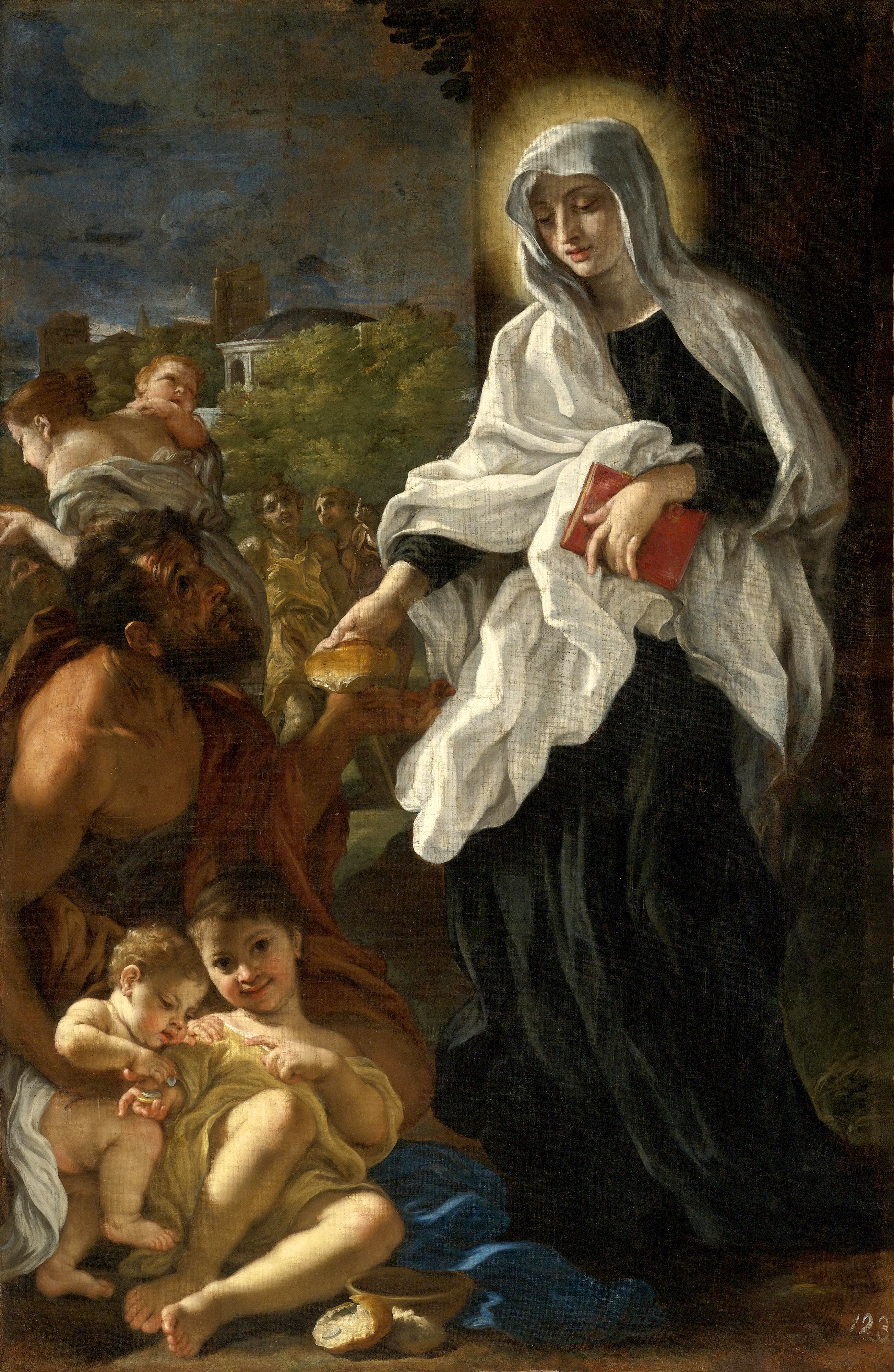
Image: Blessed Ludovica Albertoni Distributing Alms (c. 1675) by Giovanni Battista Gaulli.


Leave a Reply