
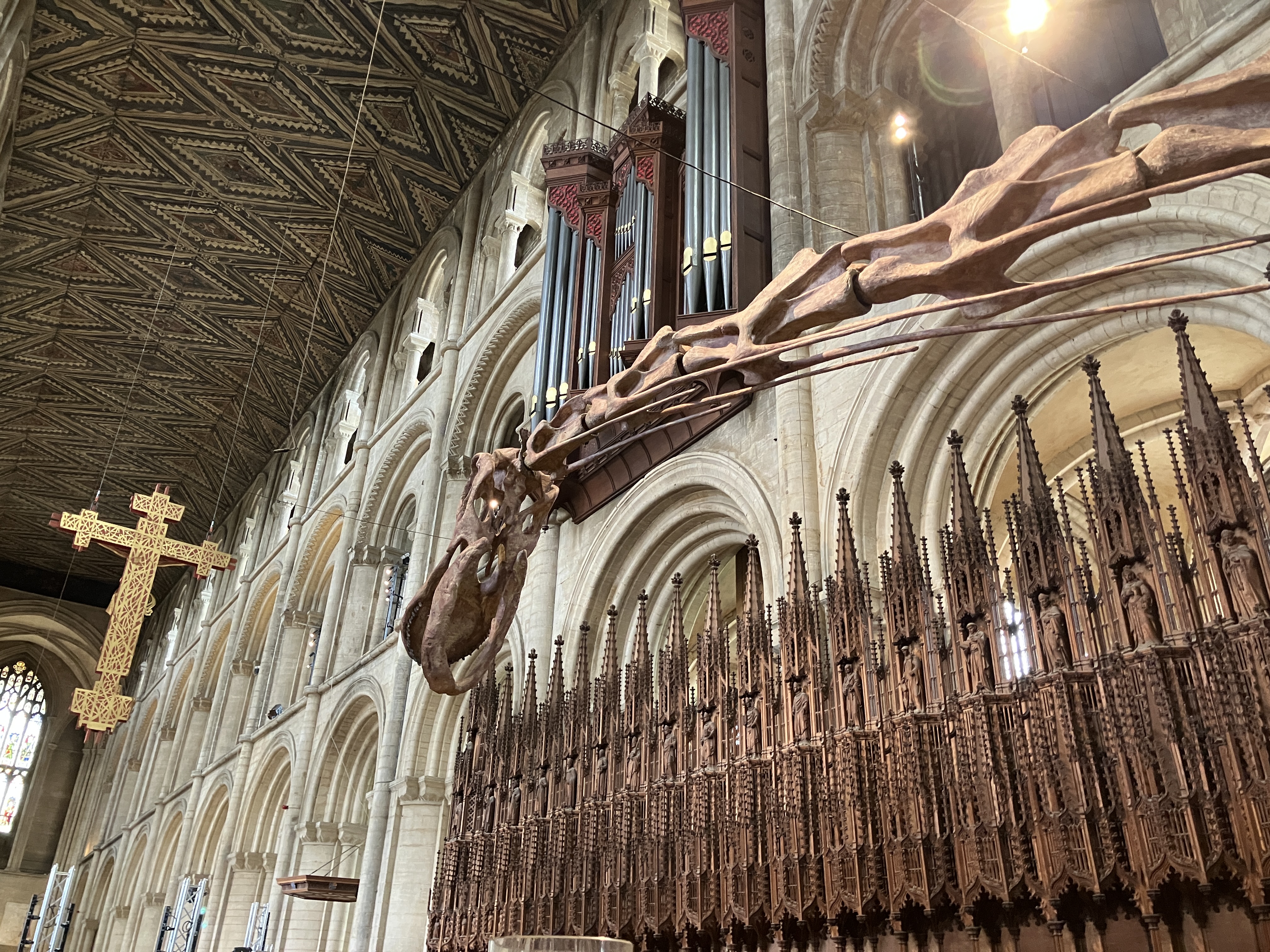
Last weekend I had the joyful experience of singing Evensong at Peterborough Cathedral. Sandwiched between a stage for a Radiohead tribute band, and the cast of the world’s largest dinosaur, the Titanosaur, on loan from the Natural History Museum, the service was both bizarre and brilliant.
The cast of the dinosaur is set up so that, from where I was sitting, it seemed to be contemplating the back of the cross. I sat and contemplated it in turn. The largest of the dinosaurs, it required a cavernous cathedral to house it on its first trip out of London. Had it been alive, it would have run away in seconds. We tamed it in death and replication. In being confined to the building, it also represented nature domesticated by architecture.

The Titanosaur cast from the choir stalls, gazing at the back of the cross. Photograph by the author.
Its gaze focussed on the cross, golden from behind, almost sun-like. It could lurch forward and destroy it, or be drawn through it into a more modern world. As I considered the temporal incongruity of juxtaposing a dinosaur with Christianity, I started to reflect on questions of history, redemption, and man’s need to engage with this (from a child’s “Did God create the dinosaurs?” questions onwards). This led me to think of Dante’s inferno, and the ongoing need to Christianise Virgil, to “rescue” him from his pagan context. Context determines so much of religion – your birth time and country may dictate much of this. I have no quick answers, but a dinosaur in a cathedral seemed like a great way to remind us that God is omnipotent, extratemporal, and ineffable, and it would be denying his power for me to worry that anyone, or anything, was beyond his care.
It also provided a challenge. For the people who claim the earth is only a few thousand years old on biblical datings, what do you do when offered such a material challenge? The Church was meeting creationism head-on in a creative way.

The view down Peterborough Cathedral, with the crucifix over a stage, and dinosaur cast behind. Photograph by the author.
I looked down the nave from the other end, beholding the cross over the tribute band stage, and the dino head behind it. History in action. Only from the front can you tell it’s a crucifix, not just a cross. We put Jesus back into the picture. Perspective in action. What does it mean to see things through those layers of chronology? The church itself, at roughly 1400 years old, is closer to Jesus in timeframes than it is to us. The dinosaur puts that into stark focus, however, adding millennia to the timeline. We marvel at the cast, which is but a skeleton of the creature, and a reproduction at that. It is still mighty. The cathedral itself is in many ways the skeleton of the ecclesia, rather than the ecclesia itself. Classical scholars would translate ecclesia as “assembly” to an NT scholar’s “church”. The church is not just a building. It is the community who need and use that building. Peterborough is reconfiguring what that means, in multiple, glorious ways. The giant “book” offering the information on “what’s on” felt almost satirical, as well as inviting, riffing on the concept of a book of hours, a tourist leaflet, a “what’s on today” in the context of “we’ve been here centuries”.

A giant “book” outside the cathedral, showing what’s on, in historical context. Photograph by the author.
The Radiohead tribute concert celebrated human creativity. That is itself a way to glorify God, giving thanks for the original band. Our Evensong was more conventional in its worship style, but blended music from different centuries, in the shadow of a creature whose longevity puts those centuries into context as just a fragment of the world’s time. As the burial place of Katharine of Aragon, and temporary burial place of Mary Queen of Scots, the cathedral celebrates continuity and change, local life, and that of the wider United Kingdom in its European context.
The canon thanked us for even our rehearsal, acknowledging how many people stopped to listen, and how the music will have affected casual visitors as well as worshippers. We were there for a few hours, on ground that has been hallowed for centuries, and trodden for millennia. We had something to add to that, however small. I listened for the layers of echo every time we ended something “right” and the building responded. The smile on our conductor’s face, the breathtaking power of rebound and silence, in the knowledge of the building having done the same for so many other people, was exquisite. Imagining how immeasurably more powerful, reverberating, and corporeal listening to an amped band would be that night left me gasping in anticipated awe. I always try to stop in a church or cathedral when I visit, not just to look around, but to pray, to use the building for its purpose. Peterborough Cathedral invited me to rethink that purpose in action. Yes, I could pray quietly, but I could also sing, admire, contemplate, wonder, and wander. Prayer comes in many forms, after all.
I once slept in Downham Market church, on pilgrimage. We’d arrived sodden, and the hall hadn’t been able to manage quite that many wet people with wet kit, so a group of us were invited to decamp to the church. Drying my things over the pews, using kneelers as makeshift pillows, it was an unconventional but perfect night. The church offered me shelter in a storm. Isn’t that what it was supposed to do? Many churches are now opening themselves up for people to stay overnight. I was reminded of this as I sat in Peterborough Cathedral wondering what churches were FOR. On the one hand, it was surreal to find so much dino-merch alongside the rosaries in the gift shop. On the other, I knew it would excite children, get them into the cathedral, introduce them to a sacred space in an unintimidating manner.
People talk about deconsecrating more churches so they can become “useful”. It seemed to me that Peterborough is doing something much more important than that. They don’t need to become “useful”, because they’re alive, with the house of God offering hospitality, history, and joy for all visitors. Prayer becomes a way of life, when encountering the sacred becomes a part of daily life.
By Cressida Ryan
For some more information on the Titanosaur in residence, see:


Leave a Reply