
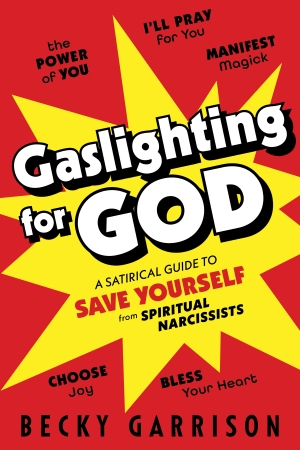
Becky Garrison has written A Satirical Guide to Save Yourself from Spiritual Narcissists (Lake Drive Books, 2026) which is the subtitle to this accessible and important book. Churches in Australia have started to respond to the evidence that clergy have higher levels of narcissism than the general population by implementing pre-formation screening. This, however, does nothing to address the problem of clergy who were ordained before these measures kicked in, or those who are able to fool the psych screening, or those for whom the power and authority of being clergy triggers latent narcissism.
I’ll break out in unholy hives if I’m forced to sit on a hard wooden pew, surrounded by even more hardened knotty souls. (4)
Garrison is described in the bio as a ‘religious satirist’ who has written and been an editor for The Wittenburg Door, and the satirical tone is particularly evident in the first part of the book where the serious issues of clerical narcissism and its abusive impacts are interspersed with humorous flippancy that occasionally felt jarring for this reader. I am not opposed to lightening the mood when discussing seriously difficult topics, but a few times the juxtaposition felt a bit disconcerting.
One of the excellent things about this book is that Garrison bases her claims not on theological feelings that too often justify pre-existing biases but on actual research of clinical therapists and others with ‘actual expertise’ (11). She helpfully notes that the extent of true narcissism is probably quite small, but that one doesn’t need to be a narcissist to cause spiritual wounds. While reading the narcissist quiz on page 62 (for leaders who are questioning if they are blessed or full of BS), I was aware that many of the questions described situations I recognised from different church contexts over the years, unfortunately.

Garrison talked about the Christian industrial complex in the United States which provides a rich environment for spiritual narcissism to flourish. It made me wonder about the different drivers of spiritual abuse in Australia. Australia is not as vocally Christian as the United States, however, most of our leaders are still at least nominally Christian. The capacity to make a living out of Christian publishing or speaking tours is virtually non-existent given our small market size. This means however that Christian influencers are often beholden to the limits of their day job, often connected to a church or other Christian institution. This positioning often places doctrinal limits on what one is allow to say, and create different avenues and cultures in which spiritual abuse can fester. The closest example of the Christian industrial complex in Australia is perhaps the Hillsong movement, which has been floundering under recent revelations of abuse world-wide, demonstrating that Australia is not immune, just slightly different.
I was disappointed to read that some of the progressive Christian writers that I follow have continued to support an abusive friend despite their rhetoric of believing women, demonstrating that power, money and networking are powerful draws even for those who lean left. In light of this, I have unsubscribed from those writers’ newsletters in order to make a small stand of refusing to stand with those who tolerate abuse – even if they are not narcissists themselves.
Unfortunately, spiritual abuse is ubiquitous creating a need for this sort of text. Fortunately Garrison has been able to tackle this difficult topic with thoughtfulness and care, producing a very accessible resource for anyone who thinks they may be dealing with a spiritual narcissist (or an everyday spiritual abuser).


Leave a Reply