
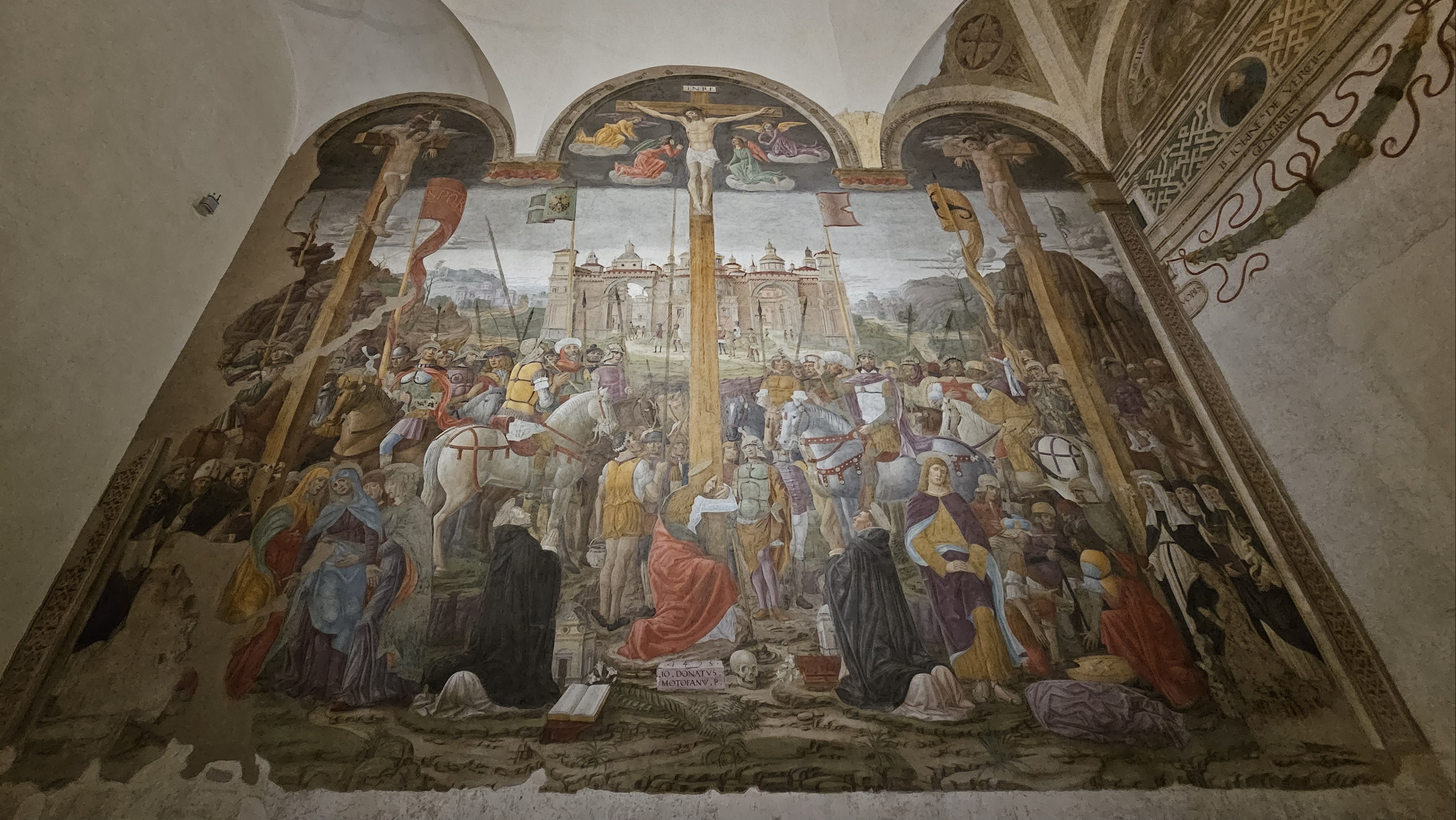
‘Crucifixion’ (1495) by Giovanni Donato da Montorfano, photographed by me at The Last Supper Museum in Milan, Italy.
Easter has been a major Christian holiday, celebrated by billions for millennia. How we tell and are told the Easter story impacts our world in profound ways. Linguists believe that the name, Easter, possibly originated from Ostern, the German word for Easter, which means “of the east (rising sun).” This reflects the imagery of dawn and a new beginning. Other European languages borrow from the historical origin of Easter, the Jewish festival of Passover, adopting the biblical Greek word “Πάσχα (paskha, Passover)”—as seen in Scandinavian Påsk/Påske, French Pâques, Dutch Pasen, Spanish Pascua, and Italian Pasqua.
Acknowledging the roots of Easter celebration in the ancient Jewish religion contributes significantly to understanding the meaning of Easter. Paul also highlights in 1 Corinthians 5:7, “Christ, our Passover Lamb, has been sacrificed for us.” The four Gospels present Christ’s suffering as bringing salvation, framing his crucifixion as an absolute act of sacrifice. Within these narratives, his innocence is illustrated as fully vindicated through his incarnation, ministry, and divinity. In response, believers are invited to recognize their sins and bow down before Christ’s humility and mercy toward them. Preachers often focus on glorifying the Son of God, the disciples who authored the Gospels, and the other disciples of Jesus. All of whom have a male body. Here, capitalization is employed to refer to the canonized gospels.
Many around the globe marvel at this sacrificial act of Christ we call Easter by attending a church service, in prayer, or being moved by Christian artworks like pietà, portraying the virgin Mary grieving her son’s dead body; with Michelangelo’s pietà in St. Peter’s Basilica in the Vatican city being one of the most well-known of the many versions of pietà.
With that rich history, what if we were not exactly told what the Gospels actually say about the Easter story? What if the depictions of the grieving, pure virgin Mary in pietà is not what the Bible says? In fact, none of the canonical Gospels and any other biblical or apocryphal texts says Mary the mother of Jesus touched or held Jesus’ dead body.
While the four Gospels describe slightly differing Easter accounts, it is worth noting that in the synoptic Gospels, all the followers of Jesus named for being willingly present at the crucifixion were women. Another element that is often omitted in Eastor sermons is Simon of Cyrene, a passer-by who appears in the synoptic Gospels and whose religious affiliation is not explicitly revealed. Nonetheless, this pilgrim from North Africa shared the suffering and humiliation with Jesus by bearing the very cross Jesus was carrying (though it is ambiguous whether he was compelled to do so or was forced by the Roman soldiers). Simon is also not mentioned in the Gospel of John.
One thing that is recorded in all four Gospels is that Mary Magdalene was present at the crucifixion. The other names invoked as being present were also women:
- Mary the mother of James/Joses (only in Matthew and Mark)
- Salome (only in Mark)
- Mary wife of Clopas (only in John)
- Mary the mother of Jesus (only in John)
- Many other women (in all three synoptic Gospels)
Matthew 27:55 records, “And many women who had come from Galilee with Jesus to care for him were watching from a distance.” This is repeated in Mark 15:41, and a slight exception to the only-women rule is observed in Luke 23:49, which writes, “all his acquaintances, οἱ γνωστοὶ αὐτῷ/ all those who knew Jesus stood at a distance, and the women who had followed him from Galilee.” This could have potentially included his disciples, οἱ μαθηταὶ αὐτοῦ, however, considering how meticulous Luke is with his textual articulation, this word choice suggests that he may have intentionally left the disciples unnamed. Then in vv. 55-56, Luke mentions only the women followed Jesus’ body to the tomb and saw his body laid in it. Then upon returning, the women “prepared aromatic spices and perfumes” for his corpse although this was not a task dedicated to women only.
The Gospel of John does not mention the women. Rather, John 19:25-27 mentions, “the disciple whom Jesus loved” was at the cross beside Mary the mother of Jesus and Jesus said to this disciple to make Mary his mother. In vv. 38–40, Joseph of Arimathea is coordinating the burial of Jesus, and Nicodemus (only in John) wrapped Jesus’ body with the aromatic spices in accordance with the Jewish burial customs. Meanwhile, all three synoptic Gospels record that the women brought the perfumes and spices at the burial and used them on Jesus’ body then encountered the angels.
The Gospel of Matthew writes that when the angels told the women (Mary Magdalene and Mary the mother of James who was with Joseph at burial) to go quickly and tell the disciples that he has risen from the dead, the women ran from the tomb with fear and great joy to tell the disciples (Matthew 28:5-8).
The Gospel of Mark introduces a nuance in addition to what is written in Matthew by saying that the women (Mary Magdalene, Mary the mother of James/ Joses who were at burial and Salome) fled from the tomb, trembling and bewildered, but said nothing to anyone because they were too frightened. Then they briefly told Peter and his companions (Mark 16:5-8). But the longer ending manuscripts of Mark write Mary Magdalene told the disciples that she saw Jesus was alive, and they did not believe her.
The Gospel of Luke adds yet another layer stating that the women, no names specified, were terrified and bowed with their faces to the ground when two men in dazzling attire (otherwise “angels” in other Gospels) appeared and said, “Remember what he (Christ) told you back in Galilee that the Son of Man must be betrayed into the hands of sinful men and be crucified, and that he would rise again on the third day (Luke 24:5-9).” Then the women remembered that Jesus had said this to them. Following that, Luke 24:10-12 writes,
“…when they returned from the tomb they told all these things to the eleven and to all the rest. But these words seemed like pure nonsense to them, and they did not believe them. But Peter got up and ran to the tomb. He bent down and saw only the strips of linen cloth; then he went home, wondering what had happened.”
The women who delivered the news to Simon Peter and the other disciples in Luke were Mary Magdalene, Mary the mother of James, Joanna, and other women. Not only was the news of resurrected Jesus hard to believe, it was more so since it was told by the women.
Meanwhile, according to the Gospel of John, only Mary Magalene came to the tomb at the dawn. No one else is mentioned (John 20:1-2), and there is no encounter with the angels which is in the synoptic Gospels. Then she runs to Simon Peter and the other disciple whom Jesus loved and told that Jesus’ body is gone, which is different from believing in his resurrection. Peter goes out to the tomb and saw the strips rolled up, but still, it is not declared he knew. It was actually “the other disciple who had reached the tomb first, came in, and he saw and believed (John 20:8).” This disciple is known to be John the son of Zebedee and the author of the Gospel of John.
What is crucial in John 20:8 is that it does not declare he believed in the resurrection, but that he finally believed Mary Magdalene’s witness account in v. 2, “They have taken the Lord from the tomb, and we don’t know where they have put him!” This is further clarified by the author’s added a comment in v. 9: “(For they did not yet understand the scripture that Jesus must rise from the dead.)” Some claim John is stating he believed the resurrection, but this is less probable since elsewhere his proclamation of faith in Christ/God, the object of his belief is made explicit (John 1:12; 3:15, 16, 18; 4:41; 5:47; 6:29, 35, 69; 7:38; 8:24, 31; 10:37-38; 11:25, 27; 12:44, 47-48; 13:19; 14:1, 10-11; 16:27; 17:8, 20; 20:31).
After the disciples leave the tomb, Mary remains alone weeping. And two angels appear and ask why she is crying. She recites again, “They have taken my Lord away, and I do not know where they have put him!” She turns around and sees Jesus standing there but does not recognize him. It is not until v. 16, the resurrected Jesus is seen for the first time, “Jesus said to her, “Mary.” She turned toward him and said in Aramaic, “Rabboni (which means Teacher).” This is a deliberate narrative emphasis on Mary Magdalene that foregrounds her as the first to witness and recognize the risen Christ, who calls her by her name.

Copyright © The Mets (Metropolitan Museum of Art) Collection Open Access
Across these Gospel records we explored, I cannot unsee that the women are central to the Easter story, which lifts up their faith, faithfulness, and childlike-ness that filled them up with fear as well as joy in knowing the Messiah. The women were not arbitrarily placed in the disciples’ story. They were the epicenter of the Easter proclamation who witnessed, told the truth, and mourned near the broken body of Christ. Call it bravery or blindness.
Why does this focus on the women in the Easter story matter?
It matters because a woman’s testimony was not legally valid in the first-century Jewish court of law that Jesus choosing Mary Magdalene as the first witness was culturally peculiar and absurd according to Josephus (Antiquities of the Jews 4.219) and the Mishnah (Rosh Hashanah 1:8).
It matters because we still live in the vile aftermath from millennia of misogyny where our mothers, grandmothers, aunts, sisters, wives, friends, teachers, and colleagues have long been asked to, or forced to, dim their light and lower their voices. Even when they spoke, they were not believed.
It matters because interpretations of the Bible transmit immense moral authority in postsecularism, leading to determinative narratives that shape our physical and social survival in terms of power between men/women, citizens/migrants, cisgender/transgender, and other axes that divide us.
Every time we overlook “the women” and distrust their witness, it does not defend Easter. It betrays it.
.
.
.
Further reading:
Brock, A. G. 2003. Mary Magdalene, the first apostle: The struggle for authority. Cambridge: Harvard University Press.
Setzer, C. 1997. Excellent women: Female witness to the resurrection. Journal of Biblical Literature (116/2): p. 259-272.


Leave a Reply