
Advent has begun, that season when we await the coming of God in Jesus by singing the beloved and richly pedigreed hymn “O Come, O Come Emmanuel.’ In my parish, we sing a modified version of this hymn.
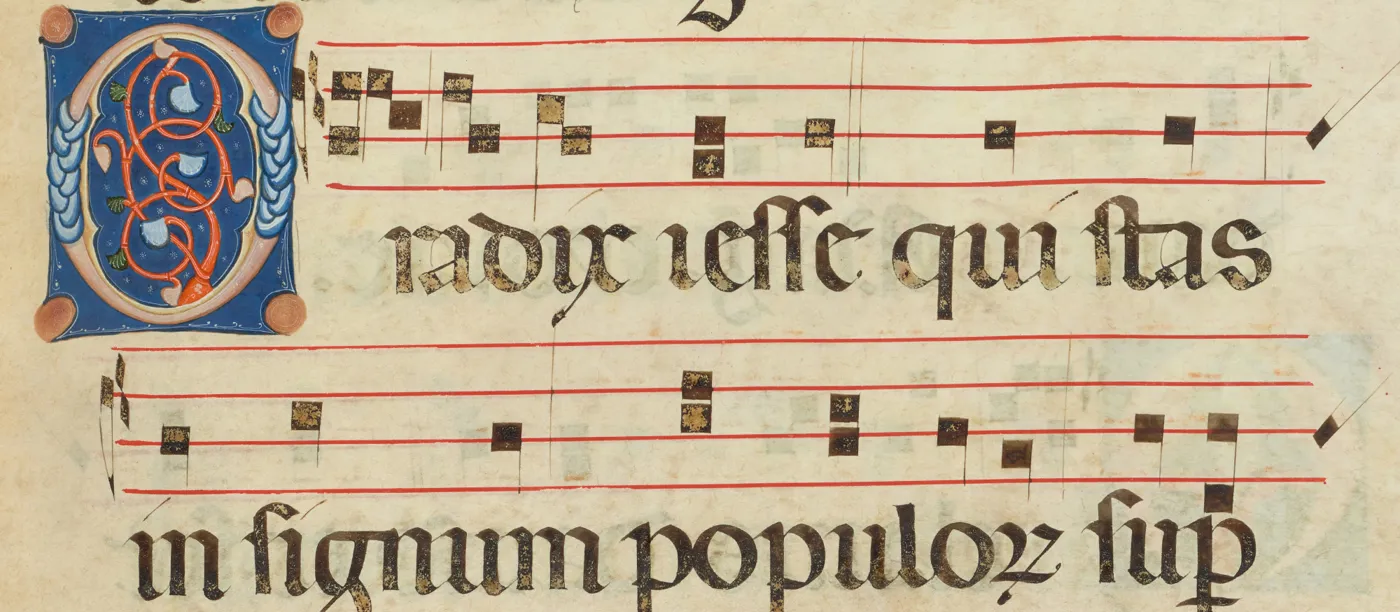
The version most familiar to Episcopalians has its roots in a series of translations and modifications of seven medieval O Antiphons traditionally sung each day during the last week of Advent. These Latin texts were compiled and modified in 1710 by German Jesuits. In 1861, John Mason Neale used this compilation to write lyrics that he then set to the melody of a funeral litany, likely from the fifteenth century in France. The Rev’d Dr. Daniel Joslyn-Siemiatkoski notes that our familiar version of the hymn, “that for so many conjures up feelings of ancient mystery and deep tradition, is in many ways a modern invention” (I owe most of my work here to Joslyn-Siemiatkoski, and all quotations unless otherwise noted are from Daniel Joslyn-Siemiatkoski, Resisting Anti-Judaism: Practices of Christian Solidarity, Chapter 4, “Resisting Anti-Judaism During Advent and Christmas,” forthcoming with Fortress Press, 2026).
In the last century, as Christians reckoned with the deeply embedded anti-Jewishness that created the conflagration of the Shoah (the Holocaust), frequent objections to this beloved hymn arose. At significant issue is the most well-known verse, which contains a lyric of Neale’s own composition: “And ransom captive Israel/That mourns in lonely exile here.” These opening words “relegate Jews to a state of exile,” not simply from their nation and land (which is no longer the case given the State of Israel), but also from God, whose appearance apparently depends, according to the hymn, on the Son of God, Jesus. Jews are “lonely,” “exiled,” and, as Joselyn-Semiatkoski notes, “passive,” rendered as waiting objects of God’s saving work rather than ongoing participants in God’s redemptive work of redeeming the captive and rescuing the prisoner.
The underlying theology of these phrases is one in which the church replaces Israel in God’s affections and attentions, a central pillar of Christian supersessionism. Yet 20th century engagement between Jews and Christians emphasizes that Christians, via the church, are in relationship with God, who was, and is, and always will be, the God of Israel. The metaphor for the church emphasized in Catholic encyclicals such as Nostra Aetate and Lumen Gentium is as the new people of God (NA, 4; LG, 2). Rather than replacing Israel as God’s people, Christians are an expanded people of God who participate in God’s faithfulness to all of God’s people, which continues to include the whole Jewish people. The faithfulness of the God of Israel is amplified through God’s faithfulness to the church.
This extension and amplification is a far more accurate reflection of the original intent of the O Antiphons. The original Latin text binds Christians to Emmanuel, the “hope of the nations.” The medieval Latin source for our distinctly modern hymn is intended to connect the singers with Israel, not replace Israel with the Church. According to Joslyn-Siemiatkoski the varied imagery of each verse draws on titles that connect Jesus with the “redemptive and revelatory activity” of the God of Israel. While the O Antiphons are distinctly Christological, in their original composition their meaning “affirms the continuing value of what was revealed to Israel.” Christians are reminded that the promise of the one who comes rests on the foundation of “the spiritually vibrant life of Israel that made the first coming possible and will abide as a reality into God’s future.”
The particularly offending phrase was added by John Mason Neal, and is completely absent from the Latin text: “ransom captive Israel; That mourns in lonely exile here.” It is based on a variation developed by German Jesuits in 1801 that asked that Emmanuel “Free captive Israel!/Who groans in exile, ’Set free by God’s Son” (Joslyn-Siemiatkoski). According to Joslyn-Siemiatkoski, “the Neal translation intensifies the language, from Israel groaning in exile to ‘mourning in lonely exile.’”
The objection to this intensification, especially in light of the dangers of Christian anti-Jewishness, has resulted in various attempts to either modify or entirely rewrite the lyrics of O Come, O Come Emmanuel. The Boston College Center for Jewish-Christian Learning provided a revision of the hymn accompanied by a commentary (PDF version). Homiletics professor and Lutheran pastor Barbara Lundblad composed a full revision which is specifically highlighted in “Christian-Jewish Relations: Theological and Practical Guidance for Episcopalians.” Episcopal Priest Stephen Shaver produced a version that has been set to music. I currently use (with minor modification) the revision composed by Dr. Philip Cunningham as a part of BC’s conversation many years ago, which is where I was first exposed to this particular conversation.
Each of these modifications serve to amplify the core Jewish identity of Jesus, and the varied metaphors speak to God’s redemptive work through Israel, and extended through Christians. Joslyn-Siemiatkoski encourages us to “imagine the redemptive landscape as not linear but looping and intertwining,” a “tapestry” the threads of each antiphon “conceived as different colors that first are woven into Israel’s story and then the Church’s story.”
It is my hope that by singing shifted lyrics, and understanding why they are shifted, we rest with great confidence in a covenanted life with the God of Israel that is not replaced or superseded by Jesus Christ, but eternally being fulfilled in our mutual participation in God’s redemptive work.

Leave a Reply