
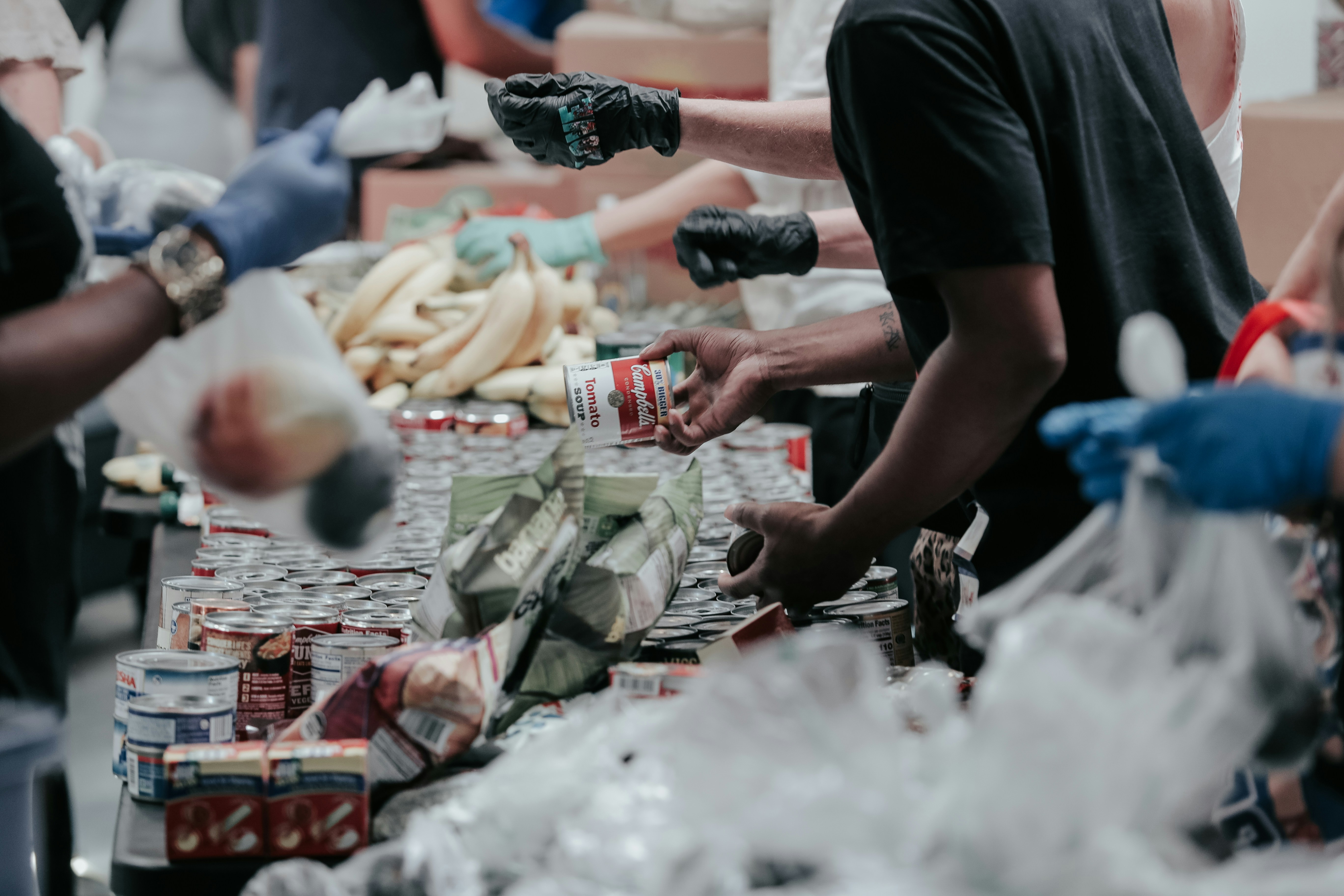
Thanksgiving is weeks away, and food banks are in crisis mode as record numbers of families face the effects of delayed SNAP benefits, rising cost of living, a government shutdown, and an uncertain economy. More than 40 million people rely on SNAP benefits to put food on the table, with the majority of recipients being children and the elderly. The halt in SNAP benefits abandons our most economically vulnerable members of society. The Thanksgiving table, which should symbolize abundance, has become for some a reminder of lack. Thanksgiving should conjure images of tables filled with turkey, mashed potatoes, and pumpkin pie. This year is different.
The cultural imagery of full tables across the country feels disconnected from reality. Hunger is a heartbreaking truth for many who are financially strained and unsure how they will put food on the table. The Bible addresses hunger in both the spiritual and physical sense, and the feeding of the 5,000 is a story that acknowledges the duality of hunger.
The miracle of the feeding of the 5,000 (Matthew 14:13-21; Mark 6:30-44; Luke 9:10-17; John 6:1-15) is one of the few stories recorded in all four Gospels, a testament to its profound spiritual significance. The book of John almost falls beautifully in line with the Synoptics when describing what occurred during Jesus’ miracle of multiplication. Each Gospel states that Jesus had the people sit down, took the loaves, gave thanks, and then distributed them to the people.
Each step, from sitting to taking the loaves, looking up to heaven, and expressing gratitude, is a key element in the miracle. However, it is the eucharistic “giving of thanks” that seems to be the final catalyst for multiplication. The Greek term eucharisteō literally means “to give thanks.” The feeding of the 5,000 demonstrates that Thanksgiving is an act of perceiving grace where we might otherwise see only insufficiency. Gratitude acknowledges that what we have, though limited, can become abundance in the hands of Christ.
Thomas Merton once said that “the grateful person knows that God is good, not by hearsay but by experience.”1 Before Jesus fed the 5,000, the crowd was tired and faint. Perhaps as Jesus alleviated their hunger, they would have been grateful, not just for the bread, but also because God saw their hunger.
Another point made in the feeding of the 5,000 was the gathering of the uneaten fragments. Nothing went to waste. Jesus instructs the disciples to “gather the leftover fragments, that nothing may be lost” (John 6:12). The action demonstrates resourcefulness, but also shows that nothing given to God is ever wasted.
Resourcefulness is the fruit of gratitude. In the Bible, resourcefulness and responsibility are often equated with stewardship. To be resourceful in a Biblical sense is to live as a steward of grace. Rhoads defines stewardship as “responsible management and sacred trust.”2 Resourcefulness is doxological, and the feeding of the 5,000 shows that being resourceful is not about individual accumulation but about creative allocation for God’s glory.
It’s easier to be resourceful when we are grateful. In the Psychology of Gratitude, Emmons wrote, “Gratitude compels us to return the benefit that we have received, and there is evidence for this cross-culturally. The link between gratitude and generosity transcends culture.”3
It’s no coincidence that the feeding of the 5,000 comes after the story of Herod’s banquet (Mark 6:21). The juxtaposition of a wealthy leader, indulging himself with the elites of society, stands in stark contrast to Jesus’ leadership. While Herod feasted in luxurious settings with an abundance of food, Jesus fed thousands in the desert with meager provisions.
The location of the feeding in Galilee also speaks to the nature of Jesus’ miracle as a protest against injustice. Galilee was a place of great affluence; however, that wealth was highly concentrated, and the majority of Galileans belonged to the lower class. Theologian Elizabeth Johnson refers to Galilee as both a “geographic region and a social location, serving as shorthand for the scandal of God’s compassionate preference for the lowly of the earth.”4
The ruling class exploited the peasants who lived in Galilee. In addition to working the land and sea, the people of the region lived under the weight of a triple tax, which flowed to the emperor, the local Jewish rulers, and the Temple. The heavy taxation and general inequities would have meant that most Galileans lived in generational poverty and cyclical indebtedness.
Sociologist Gerhard Lenski writes about the reality that Galileans faced living in a society with “basically two major classes, upper and lower, with an enormous gap between them.”5 In America and around the world, wealth is concentrated among the one percent. The feeding of the 5,000 was a brief moment where the class divide was shattered. Everyone was invited to the feast.
Government oppression and taxation created fertile ground for revolts and rebellions in the region where Jesus fed the 5,000. Hunger was a reality for many, and scripture illustrates that point when, one day after the miracle, the crowds search for Jesus, hoping for more food. Jesus redirected the crowds towards spiritual food that satisfies the soul. Jesus uses rich eucharistic language, stating, “I am the bread of life. Whoever comes to me will never go hungry, and whoever believes in me will never be thirsty” (John 6:35). Jesus came not only to address physical hunger, but spiritual hunger as well. His ministry was undergirded by a eucharistic life of love and compassion for those less fortunate.
This Thanksgiving season, perhaps we are being called back to that kind of compassion and thanksgiving seen in the feeding of the 5,000. It’s a eucharistic gratitude that doesn’t ignore the world’s pain but meets it with open hands. The boy’s small offering of loaves and fish, when compared to thousands of empty stomachs, looked like a reminder of lack. But when surrendered to God, it became more than enough. When we bring our tiny offering of fish and bread with a heart of thanksgiving, God can multiply what we give this season.
1. Thomas Merton. Thoughts in Solitude. New York: Farrar, Straus and Giroux, 1956 (revised 1999), p. 33.
2. David M. Rhoads. “Stewardship of creation.” Currents in Theology and Mission, vol. 36, no. 5, Oct. 2009, pp. 335.
3. Robert A. Emmons. Michael E. McCullough. The Psychology of Gratitude, Oxford University Press. 2004. p. 12.
4. E. A. Johnson. “Galilee: A Critical Matrix for Marian Studies.” Theological Studies, 70(2), 327-346, 2009.
5. Gerhard Lenski. Power and Privilege: A Theory of Social Stratification (New York: McGraw-Hill, 1966).

Leave a Reply