
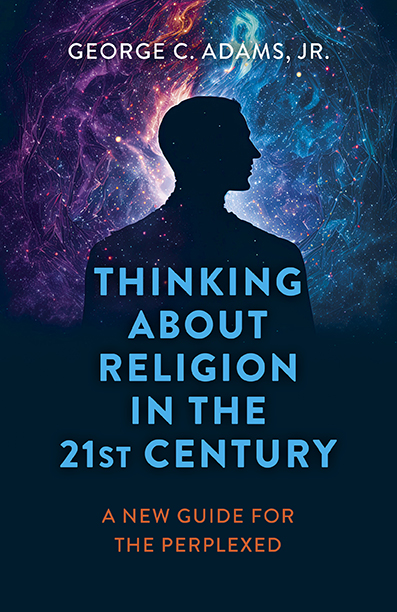
One of the most striking things about George C. Adams, Jr.’s recent book, Thinking About Religion in the 21st Century: A New Guide for the Perplexed, is its attentiveness to the needs of potential readers. In the first pages, Adams acknowledges that
given the abundance of spirituality-oriented books that address the notion of an evolutionary shift from an outdated mode of spirituality and consciousness to something new and revolutionary, one could argue that there’s not much more that can be said on the matter…Nonetheless, this book does have a unique objective, in that it attempts to examine these issues in a manner that is likely to be positively received by a broader audience.1
It is not difficult to find popular or academic publications which cover the central claims made by Thinking About Religion.2 It is, however, challenging to find a text which accessibly explores religion today and future possibilities. A skilled writer, Adams provides understandable summaries of the work of key scholars and complex concepts while also tackling uninterrogated assumptions about religion and other topics in approachable ways. Although a few discussions could have been strengthened by greater use of academic conventions, on the whole, the book fulfills its promise to offer “intellectually sound, rationally serious arguments…to the thoughtful lay reader.”3

296 pages. $21.95.
Following the first chapter, which details the overall argument and approach of the project, the book is divided into two sections: Deconstruction and Reconstruction. In chapters 2-6, Adams identifies and deconstructs various features of “traditional religion,” by which he means the dominant model of spirituality today (i.e., the Axial Age), exemplified in the world religions. Adams acknowledges that good hearted, intelligent people may struggle with traditional religion because of its strong emphasis on sacred texts, ritualized action, inflexible doctrine, and exclusivist claims. Adams’s goal in this section is to highlight the historically contingent nature of religion. While sacred texts are central to accessing the spiritual dimension of reality at this time, they may be less important for future generations in the coming post-Axial Age. Although I remain skeptical of any claims made about future spirituality, the book’s deconstructive work, particularly around sacred texts and doctrine, is valuable as it demonstrates how important historical context is to understanding biblical interpretation and orthodoxy debates.
In the second section, Reconstruction, Adams offers arguments that support the reasonableness of remaining open to the spiritual dimension of reality and, in places, gestures at potential features of future religion. Chapters 7, 8, and 13, which respectively address scientific materialism, epistemology, and religious experience, are the strongest, in part because of their deconstructive character. For instance, to tackle claims that science and religion are incompatible in chapter 7, Adams outlines the evolving nature of scientific knowledge. While certain scientific accounts may have presumed to close the door on the spiritual, advances in quantum physics, for one, insist that we remain open to all manner of “potentially unimaginable possibilities.”4 Alternatively, chapters 14 and 15, which touch on themes of suffering and meaning, classic arguments against and for religion, are weaker. While Adams attempts to concisely summarize these long-standing debates, he does so too quickly, leaving readers with an incomplete picture of both the conversation and how post-Axial religion might rethink those elements. This may be a consequence of attempting to cover so many topics in the book; there are Reconstruction chapters on consciousness, moral goodness, and perennialism as well as a lengthy, summative conclusion.
Overall, Thinking About Religion accomplishes what it sets out to do. It is an accessible, introductory text on evolutionary conversations about religion. I can envision assigning select chapters in an undergraduate introductory religion course to set up sections on hermeneutics or orthodoxy. Moreover, the book might be useful in a philosophy of religion course as it offers a contemporary perspective on key topics.
Notes:
- Adams, Thinking About Religion, 12.
- In fact, many of those resources are described in Adams’s conclusion, chapter 16.
- Adams, Thinking About Religion, 13.
- Adams, Thinking About Religion, 97.


Leave a Reply to Christine Firer HinzeCancel reply