
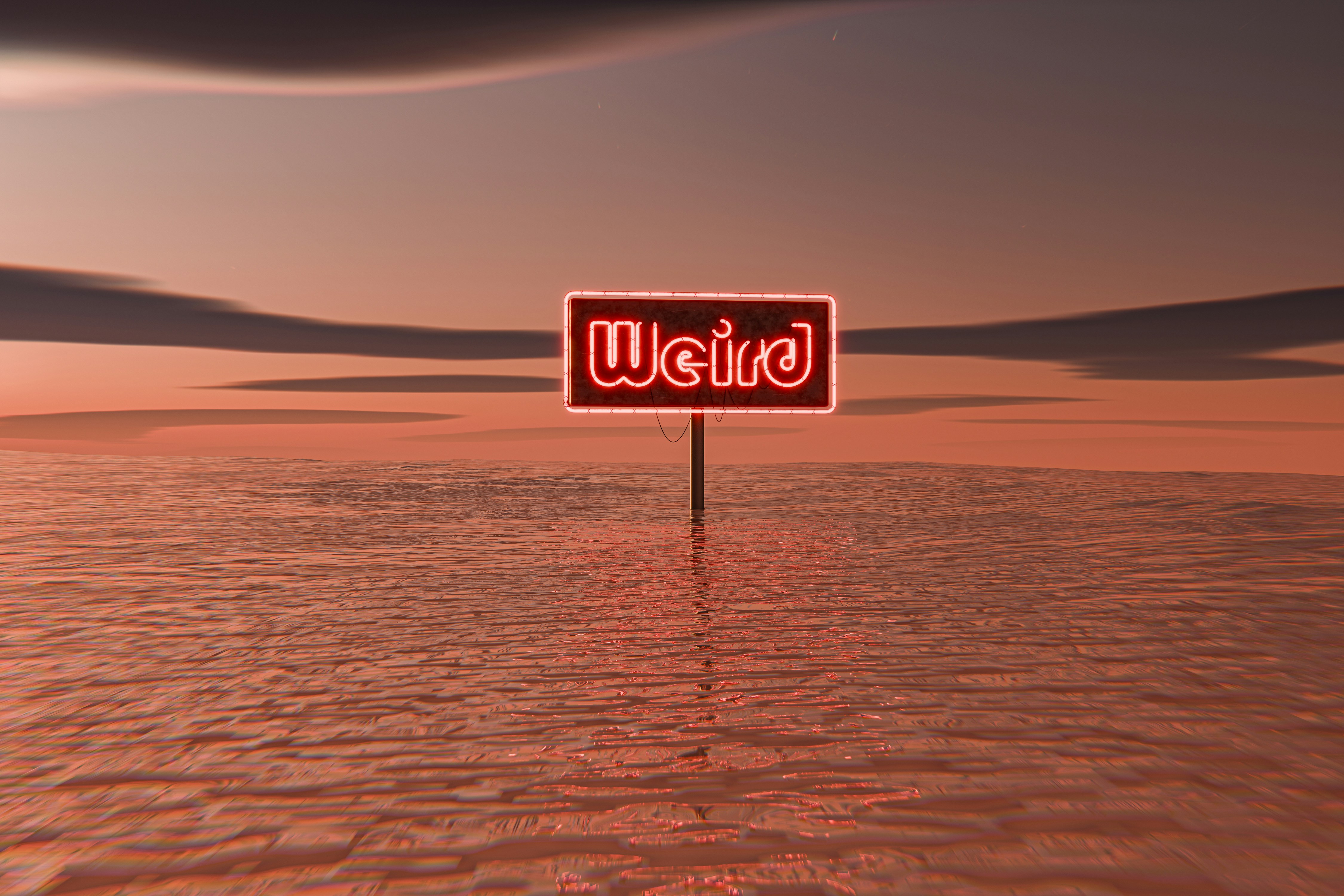
It’s been a strange couple of weeks in U.S. politics. In late July, Joe Biden unexpectedly ended his presidential re-election campaign and endorsed Vice President Kamala Harris. Not soon after, the word “weird” became a cornerstone of Democratic messaging, primarily directed towards Republican presidential nominee Donald Trump and his vice presidential pick, J.D. Vance.1 While one could say so much about either event, the latter has been weighing heavily on my mind.
The instrumental impact of the “weird” label is foremost on the minds of many.2 Will this change in tactics work for the Democratic ticket? Given that the political realm is often governed by concerns of effectiveness, this focus makes sense. A particularly vivid, albeit dramatic, example is the Netflix show, “House of Cards,” whose main character, Frank Underwood, routinely justifies morally problematic acts in his bid to secure and retain the presidency. While Underwood takes ruthless pragmatism to a new level, his political philosophy feels familiar when surveying the current political landscape. Instrumental logic also appears in conversations related to more ordinary political activity. As theologian Kyle Lambelet points out, contemporary scholars have tended to emphasize the strategic value of nonviolent action and urged citizens to adopt nonviolence as a key political practice because it works.3 Yet, with the presidential election months away and causal relationships notoriously difficult to trace, it is hard to say if “weird” will be effective in the long run. In any case, there are other conversations I think that we need to have as well.
I have complicated feelings about the term “weird” due to its multifaceted character.4 For one, “weird” can be a valuable tool of moral judgment. As ethicist Jean Bethke Elshtain observes, “judging involves calling things by their real names” and “weird” may call attention to attitudes and actions that are problematic or destructive. Judging can encourage necessary critical thinking which renders the familiar strange and prompts a vital shift in perspective.5 “Weird” holds the potential to do important moral work.
At the same time, “weird” is often coupled with the category of “normal.” While “normal” can serve as short-hand for average in a given data set, it can and has been used to discipline certain “others,” categorizing them as deviant or dangerous and justifying terrible mistreatment. Religion scholar Heather R. White provides a good example of this phenomenon in her book, Reforming Sodom: Protestants and the Rise of Gay Rights. White notes how “healthy sexuality” came to dominate thinking in the U.S. during the middle of the twentieth century. While this change showcased the importance of sexuality to human life, it did so by valorizing heterosexual, nonreproductive pleasure while also increasing worries about sexual deviance; within Protestant circles, “a newly consolidated homosexuality increasingly shouldered the discarded burden of sodomitical prohibition.”6 In other words, the embrace of certain forms of sexuality as normal and natural (i.e. heterosexual) prompted stronger exclusion of others (i.e. homosexual). Not only did this shift have implications for families and faith communities, but as White notes, the “Cold War rhetoric positioned so-called sex deviance as a threat to American national security, and new federal policies and policing practices worked to root out hidden homosexuals.”7 When coupled with “normal,” “weird” can take on dangerous undertones which, as history demonstrates, can be weaponized to harm minoritized communities in particular.
Finally, “weird” has historically carried supernatural overtones and this seems significant as well, particularly as someone who was raised Christian and continues to study Christianity.8 I grew up, for instance, in a denomination in which being weird could be a badge of honor; we were “weird,” as in distinctive and set apart for God.9 This understanding of “weird” persists in certain Christian spaces.10 For instance, a 2020 New York Times column brought attention to “Weird Christians,” individuals who “see a return to old-school forms of worship as a way of escaping from the crisis of modernity and the liberal-capitalist faith in individualism.”11 Moreover, The Weird Christian podcast, up until recently, regularly interviewed “guests who are willing to share what Christ has done in their life and aren’t afraid to get a little weird.”12 While not without controversy, these examples point to positive associations with the term, with some choosing to assign the label of “weird” to various Christian beliefs and practices.13
In the end, I still feel ambivalent about the term “weird” and its use in the 2024 presidential campaign. “Weird” is a complicated term and I am unsure of its long-term impact on this election and U.S. politics in general. I am certain, however, of my vision for our common life, and that come November, I will be voting.
References:
Elshtain, Jean Bethke. “Judge Not?” In The Moral Life: An Introductory Reader in Ethics and Literature, edited by Louis P. Pojman and Lewis Vaughn, 156-164. New York, NY: Oxford University Press, 2011.
Lambelet, Kyle B. T. ¡Presente! Nonviolent Politics and the Resurrection of the Dead. Washington, DC: Georgetown University Press, 2019.
White, Heather R. Reforming Sodom: Protestants and the Rise of Gay Rights. Chapel Hill, NC: University of North Carolina Press, 2015.
Notes:
- For more on this shift in language see Eli Stokols and Elena Schneider, “How Trump and Vance went from a ‘threat to democracy’ to ‘weird,’” Politico, July 26, 2024, https://www.politico.com/news/2024/07/26/trump-vance-weird-00171470.
- For example, see Kate Burridge and Howard Manns, “How the US election turned ‘weird’ – and why it’s working for the Democrats,” The Conversation, August 6, 2024, https://theconversation.com/how-the-us-election-turned-weird-and-why-its-working-for-the-democrats-235874.
- Lambelet, ¡Presente!, 10. Lambelet rightly cautions against focusing solely on the effectiveness of nonviolence as individuals who adopt this strategy, including but not limited to Martin Luther King Jr., do so to be faithful to foundational moral principles as well.
- Elshtain, “Judge Not?” 159.
- Some on social media demonstrate this function of “weird.” For example, see Alana Valko, “Everyone Is Calling Trump And Vance “Weird,” And It’s Working,” Buzzfeed, July 30, 2024, https://www.buzzfeed.com/alanavalko/trump-vance-weird.
- White, Reforming Sodom, 11.
- Ibid., 17.
- For more on the supernatural connotations of “weird,” see Jason Farago, “The ‘Weird’ History of Tim Walz’s Political Put-Down,” The New York Times, August 7, 2024, https://www.nytimes.com/2024/08/07/arts/tim-walz-trump-weird.html.
- First, I should note that, as a heterosexual, cisgender woman, I was not perceived to be “weird” within my Protestant denomination. My experience and perception of the word “weird” may have been different if I had been openly gay, for instance. Second, Michael Frost’s book, Keep Christianity Weird: Embracing the Discipline of Being Different, serves as another example of this mindset.
- Other individuals and groups have embraced “weird” as a descriptor for various reasons, something I won’t explore here. One example is the musician “Weird Al” Yankovic.
- Tara Isabella Burton, “Christianity Gets Weird,” The New York Times, May 8, 2020, https://www.nytimes.com/2020/05/08/opinion/sunday/weird-christians.html.
- Samuel Delgado, “The Weird Christian Podcast,” accessed August 12, 2024, https://podcasts.apple.com/us/podcast/the-weird-christian-podcast/id1556959320.
- For one critique of “Weird Christians,” see Jamie Manson, “Are ‘Weird Christians’ really ‘punk,’ or just elitist?” National Catholic Reporter, May 12, 2020, https://www.ncronline.org/opinion/grace-margins/are-weird-christians-really-punk-or-just-elitist.
Photo by Steve Johnson on Unsplash.

Leave a Reply