
Part 1: Summary & Analysis
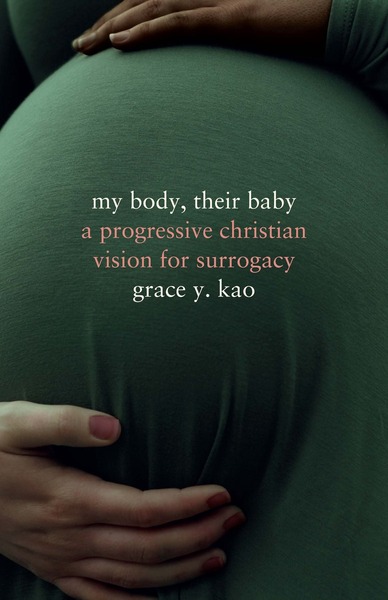
Grace Y. Kao’s My Body, Their Baby: A Progressive Christian Vision for Surrogacy is a wonderful book. Solidly researched and well-written, Kao provides a much needed resource on the practice and ethics of surrogacy. Anchoring the project with stories of her own journey as a surrogate, Kao not only affirms experience as a vital source of moral wisdom but demonstrates its value. There are ethical questions and complexities to surrogacy that would be easy to miss if not for her insider knowledge.
Carefully accounting for language choices and project parameters, Kao focuses the first half of the book on providing a robust description of surrogacy, offering a thorough primer on the reproductive technology before identifying and responding to common objections to it, especially those emerging from feminist and Christian commitments. Much of what Kao offers in these first chapters is already available across various different sources but her ability to weave together a cohesive and comprehensive account is invaluable. Kao also skillfully draws attention to underlying sexist and heteronormative assumptions about motherhood and marriage embedded in debates about surrogacy and other reproductive technologies.
In the second half of the book, Kao shifts to her normative contribution, a progressive Christian framework for surrogacy featuring seven principles. For this discussion, Kao initially focuses on surrogacy arrangements like hers – gestational, altruistic, and intrastate – to develop her account. Drawing on the four traditional sources of Christian ethics – Scripture, tradition, reason or secular sources of knowledge, and experience – Kao’s framework is holistic, offering norms to accompany different stages of the surrogacy process, from initial discernment to the years following the birth. Importantly, she carefully attends to the different needs and responsibilities of those involved in surrogacy triads, in particular the surrogate and the intended parents. Kao ends by using her framework to evaluate more complex surrogacy arrangements – traditional, commercial, and cross-border – and outlines the conditions under which each might be morally permissible. As Kao notes, the growing popularity of surrogacy and continual technological advancements demand that Christian theologians and ethicists engage in sustained analysis and critical assessment rather than dismiss new reproductive possibilities outright. My Body, Their Baby not only offers a thoughtful decision-making framework for those considering surrogacy today but also provides an excellent model for future scholarship in Christian reproductive ethics.

Stanford, CA: Stanford University Press, 2023. 274 pages. $30.00.
Part 2: Reflection
I have been thinking a lot about experience as a moral source since I finished reading My Body, Their Baby. Kao’s own surrogacy journey was crucial to her work; her personal stories add nuance and depth to descriptions and ground her normative claims. While Kao’s proposals are broadly applicable, I keep coming back to how her surrogacy experience is so uniquely hers. While it illuminates so much, I wonder if it also conceals important elements which another person’s experience could bring forth. For example, Kao shares how a conversation with one friend regarding altruistic surrogacy prompted her and her husband to agree theoretically to the possibility someday. When a request came from another friend a few months later, Kao welcomed the opportunity to become a surrogate. Kao’s description of her decision-making at the beginning of her surrogacy journey stood out to me. She writes, “all told, I had calculated that it would not be too costly – physically, emotionally, or professionally – for me to give this gift to my friends” (154). I was surprised with the assuredness of Kao’s words as well as the freedom I perceived in her deliberation.
As I reflected on my own experience, I thought of my sisters and our individual reproductive stories. For a variety of medical reasons, I would likely be the most attractive candidate within our family to serve as a surrogate should either sister desire more children. Familial ties complicate things, however, and give gifts an obligatory quality. I don’t know that I could refuse to become a surrogate if asked; the relational costs, I suspect, would be too high for me to bear even if I would wish otherwise. Moreover, I thought of the mutual aid families sometimes provide each other to navigate health crises or economic precarity. Could I opt out of reproductive labor for a sister who had provided childcare or another service when I needed it? My experience and imaginings elucidate the intractability of issues like consent and coercion even within altruistic, gestational, and intrastate surrogacy arrangements, something which Kao’s story somewhat obscures. No doubt another’s experience would highlight additional facets.
In calling attention to the partiality of Kao’s experience, I am not contesting its value. All experiences are inherently limited and her stories remain an irreplaceable gift to the project. More than anything, Kao’s book has prompted me to reexamine experience as a moral source, something which is foundational to my work as a Christian feminist scholar. My Body, Their Baby highlights how drawing on experience to navigate difficult ethical questions is both a generative and risky undertaking. Just as with Scripture, tradition, and secular sources of knowledge, care ought to be taken in the selection and interpretation of experiences. Being vigilant to the particular context of individual experiences and giving priority to the experiences of historically marginalized groups is also vital, considerations which Kao also raises. In the end, I think Kao’s challenge to tackle difficult topics like surrogacy with courage and rigor is applicable to the use of experience as well. As such a potent source of moral wisdom, experience ought not to be dismissed outright nor embraced uncritically but rather given even more serious and sustained study.

Leave a Reply