
Sermon preached by Rev. Maria McDowell at Christ Episcopal Church, Tacoma, Washington on July 14th, 2024.
One day in high school I walked into my social studies teacher’s classroom. Mrs. Lee was my favorite teacher, she remains my favorite teacher. It may be her that sparked a lot of my interest in politics. She was deeply committed to ensuring that we understood how our political system worked, and deeply committed to ensuring that we were responsible citizens who engaged in our political responsibilities well and thoughtfully. She was mild mannered and always had a great sense of humor. She was patient, she was creative. She was never angry.
I walked into the classroom and Mrs. Lee was standing at the front of the classroom holding the Oregonian in her hand facing all of us. On the cover of the Oregonian was a picture of the retaining wall of the Willamette River which was low at this time of year so much of the wall was widely exposed and somebody had taken a can of spray paint, and had painted, “Shoot Quayle First.”
This was immediately after the election and people didn’t like Dan Quayle. “Shoot Quayle First.” She was furious. If she could have been frothing at the mouth she would have been. We sat there for a five minute tirade. I have never heard anything like it. She said “this is not how we engage in our democracy. This is entirely inappropriate. You can choose to like him or not like him, but we do not engage in our democracy with political violence.” She said, “I am teaching you to use your political efficacy.” I remember that phrase, “your political efficacy responsibly and thoughtfully. You do it by voting, you do it by participating in policy change, you do it by nonviolent resistance, you do not engage in political violence.”
I read today’s Gospel passage earlier this week and I thought, oh Lord what in the world am I supposed to say about this terrible, awful, and somewhat disgusting story. It is brutal on so many levels. Herod Antipas is not a wonderful person at all. He is the son of Herod the Great, the man who killed innocent children at the news of the birth of a potential rival Jewish king. He is one of many sons and they are competing for power, and for some reason that I don’t entirely understand given the politics of the day, Herod Antipas would have more power if he was married to the wife of his brother Philip. So Herodias divorces Philip and moves into a marriage that is probably far more beneficial for her as well, bringing along a daughter, and a niece. who is invited to dance. To dance in front of a bunch of politically ambitious, well-moneyed men. This is a Hollywood scene gone horribly wrong. Drunken powerful men watching a young girl, a family member, dance in a way that I am sure was suggestive enough that all of them cheered Harod on when he says “I will give you whatever you want. Whatever you want….” And she being innocent, or perhaps shrewd having been raised in a politician’s family, goes to her mother and says “what do you want” and Herodias says she wants this man who has spoken against her and her power moves silenced. So she asks for John the Baptist’s head on a platter. And that is what they get. The death of a man who even Herod liked to listen to you.
Did you catch that? Herod liked to listen to this man. He was also perplexed by John the Baptist. He viewed John dangerously enough that he put John in prison. It wasn’t like “oh, I like what you have to say please keep saying it. I like what you have to say but I would really prefer you not say it.” Herod, a Jew raised in a Jewish world, but put in power by a Roman world, experiences a conflict between his civilizations, and John the Baptist is a reminder of that conflict, because John is doing what prophets have done from the beginning of prophets: calling people in power to put down the abusive use of their power and if they’re going to have it, use it to care for the vulnerable, to lift up the lowly. Prophets tell kings, you need to redistribute the land. You cannot keep all the vineyards for yourself, you need to give them back to the people. You need to not use the money of the people to build temples and armies. You need to ensure everybody has enough to eat. Prophet after prophet, Elijah, Elisha, Amos, Habakkuk, Malachi, Isaiah, over and over and over again they say the same thing to people of power. Use your power to care for the vulnerable and if you don’t you should not have power.”
There’s something in that vision that rings in the heart of Herod Antipas, but at this moment it isn’t enough. He needs to show off in front of his fellow leaders. He needs to show them that he will indeed keep his word no matter how brutal his word is. And so he gives his wife what she wants, which is probably convenient for him as well. This silencing of a person.
But clearly the guilt eats away at him, because when someone else comes along and begins to say the same things, he thinks that it is John the Baptist come back to haunt him.
This story isn’t a particularly nice little moral lesson for us. I’m not gonna make an association between Herod and some political figures, between John the Baptist and other political figures. Because the whole story is a horror. It says something about how power that doesn’t want to give itself up, works. It says something about how even when power thinks, oh, maybe this person is saying something I find intriguing, when push comes to shove and reputation is on the line power uses violence, political violence, to bring an end.
I didn’t really know what I was going to preach until I opened the newspaper yesterday, and realized that once again, political violence has been used, used as a tool to silence conversation. No matter where you fall in this conversation, violence begets violence, and what we see around us is a world so invested in preserving itself and the ways that we do things, the ways that we do things that ensure that the wealthy stay wealthy and the powerful stay powerful, that we will use violence to bring that to an end.
We are going to spend the next months, if not years inundated, inundated with stories that will increase our anxiety and our fear, and it is anxiety and fear that lead to violence, to that need to defend by any means necessary.
Mark offers us this story as a contrast to the story of the world that Jesus is inviting us to participate in. Instead of a world of political violence, it is a world where Jesus stops and listens to a woman on the outside on the way to the home of a powerful man to heal his daughter. Where the privilege of a position of power does not obviate the vulnerability of a person. Where the healing of Jairus’s daughter includes the healing of a woman bleeding for twelve years. Where healing for one is healing for all.
That is the invitation of the world that we are called to be a part of, to help create. To do it as a part of the life of this community, part of the larger community that we are a part of. To use our gifts in whatever way God has called us, to use them to care for those around us. It’s not a world where we will be particularly welcomed well, where compassion, joy, kindness, treating everybody as if they deserve health and shelter and education. That is a world that challenges the way power works around us, but it is the world that we are invited to be a part of.
I’m not quite sure how we will all deal with this upcoming political season and what I suspect is only an increase of verbal and physical violence. What I hope is that we take the time to fill our eyes and our hearts and our minds with the stories of the people of God, the people who have lived through the violence that we see around us and chosen something different.

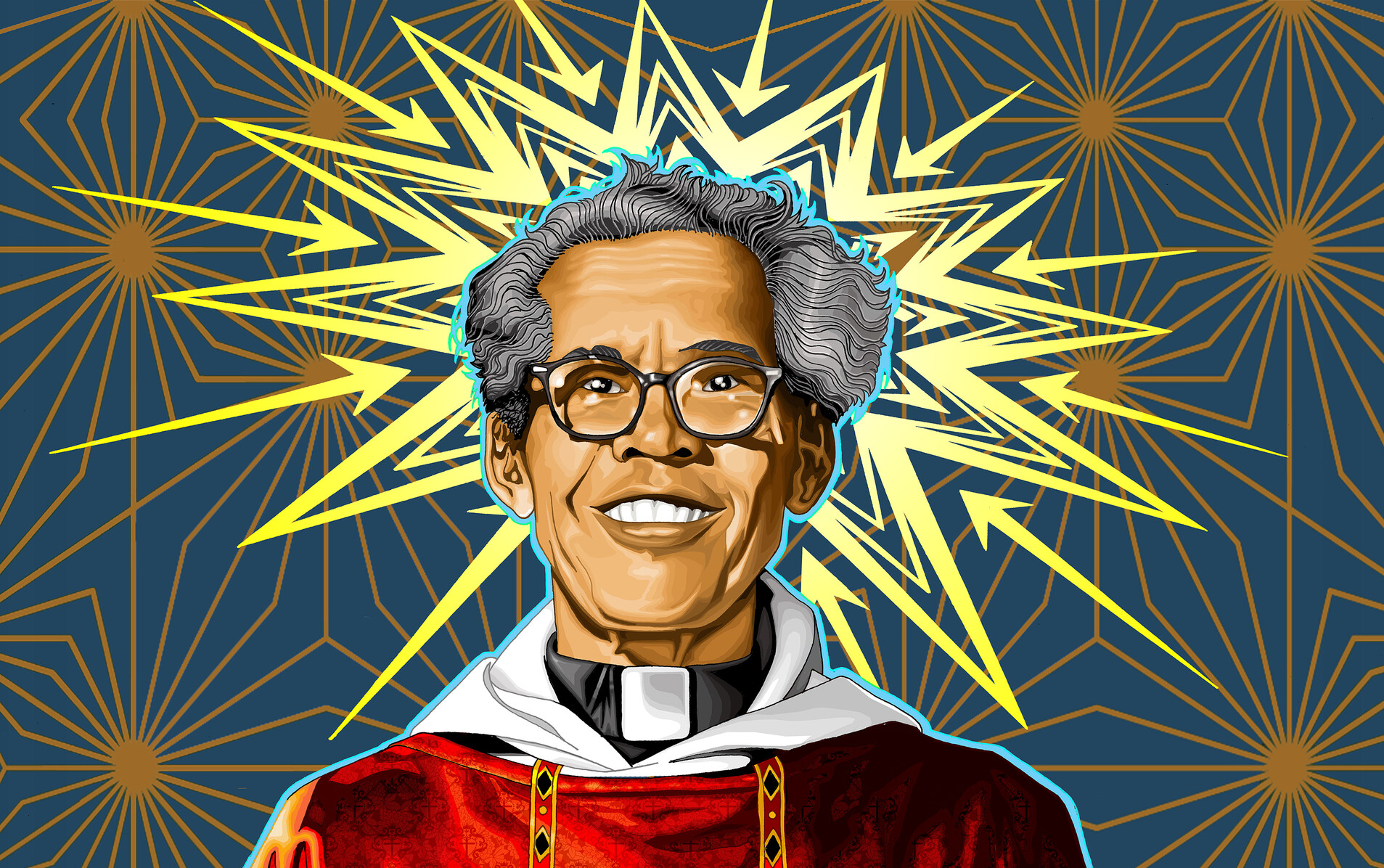
Two weeks ago we celebrated Pauli Murray, the first African-American woman ordained to the priesthood in The Episcopal Church. When she was a law student at Howard she wrote a paper in a class making an argument to bring down separate but equal, and she was laughed at by her colleagues and professors because her argument was ridiculous. It was far too hopeful. It was far too broad and all encompassing. One of those professors was Thurgood Marshall.
Image by Christopher Taylor
A decade later, when Thurgood Marshall was heading up the NAACP and invited to bring a case against separate but equal, and they were debating how to do it, discussing what argument to make, he remembered the paper of this student. Her argument is now the law of the land. Pauli Murray, who was not accepted into Harvard because she was a woman went to Howard, where she was one of the few women, and her argument became the law of the land.
When she was at Howard Pauli Murray and her friends sat at lunch counters in protest of segregation, but nothing came of it. Their protest dwindled away. A decade later it is lunch counter protests that provide one of the key strategic methods of the civil rights movement. She writes in her autobiography, we had the right idea, we didn’t have the right time, and I’m so glad these young folks have picked it up again.
Next week you will see on the cover of our bulletin an image of Mother Maria Skobtsova.

Mother Maria, originally Elizabeth, was an aristocrat from Russia exiled at the Revolution who escaped with many Russians to Paris where they had no jobs, no money, and no privilege. Maria Skobtsova was kind of notorious: multiple marriages, multiple divorces, children out of wedlock, drinking, smoking. She gathered a salon of intellectuals to talk and argue theology, theology by the way, which has seeped into the Book of Common Prayer, through the revisions of the prayer book being considered by Anglican who were engaged in conversation with Orthodox and Catholics in that period between World War I and 1979.
Mother Maria decided that she had a call to monasticism, but she didn’t really like the idea of a monastery up on a holy hill. As a matter fact, she had a lot of words to say about monasteries who separated themselves off from the people. She was going to do a monasticism in the city, and she started a soup kitchen in which she fed hungry immigrants, anybody that would come. She developed a reputation for missing liturgy because she was too busy feeding the poor. In the Orthodox Church that’s a big no-no, you do not miss liturgy.
She and her son who was an ordained priest, sheltered Jews during the beginnings of the German occupation in Paris. They would feed them, they would try to help them escape, often by forging baptismal certificates. She lied and forged Christian documents to get Jews out of Paris. She and her son and others were caught. She was executed in Ravensbruck on Good Friday 1945, a few weeks before liberation.
These are the people who choose in their lives to engage in thoughtful, critical, active resistance, through acts of love, of compassion, of organizing, of nonviolent resistance They choose to embody the reign of God in a way that does not encourage or lead to political violence.
Friends, we will be inundated with the violence of Herod. We already are all the time. It’s around us constantly. It is a story that stands in contrast to the story that we are invited to create, a story that we are invited to write. We, as Christians with a commitment to a particular baptismal covenant, are called to live out, to embody, our values in any number of ways. Volunteering, choosing to live on less money so that we can give it to organizations that we care for and think are doing what is meaningful in the world. To participating in this community as a way of caring for those around us, struggling to figure out how to care for those around us, and how to care for one another.
Whether you decide to read articles in depth lines, or just stick with the headlines, we can’t shut our eyes to the violence of the world around us. But what we can do is fill ourselves with the stories of the people of God, the prophets among us who call us to live in a different way, and to do it whether we succeed or fail. Whether we die looking back at the things we did in law school to realize that they changed the face of our nation, or if we die because we refused to allow God’s people to be herded up and sent away to die.
We are invited into a different story than we read today. And it is my prayer and my hope that together we find the strength to support one another in however it is that God is calling us to write a different story. Amen.

Leave a Reply