
WIT welcomes Mae Forrest Barnes as a guest poster. Mae is a PhD candidate at the Graduate Theological Union at Berkeley, California, with a focus in theology and ethics. Her research is primarily in disability advocacy, science and technology, and their relation to theology. She is an avid reader, writer, and cultural critic. For more of her work, you can subscribe to her work on her blog. You can also follow her for both silly and serious takes on the site formerly known as Twitter, @dr_maeforrest.
The following has been adapted for WIT from a series of posts from X/Twitter.com.
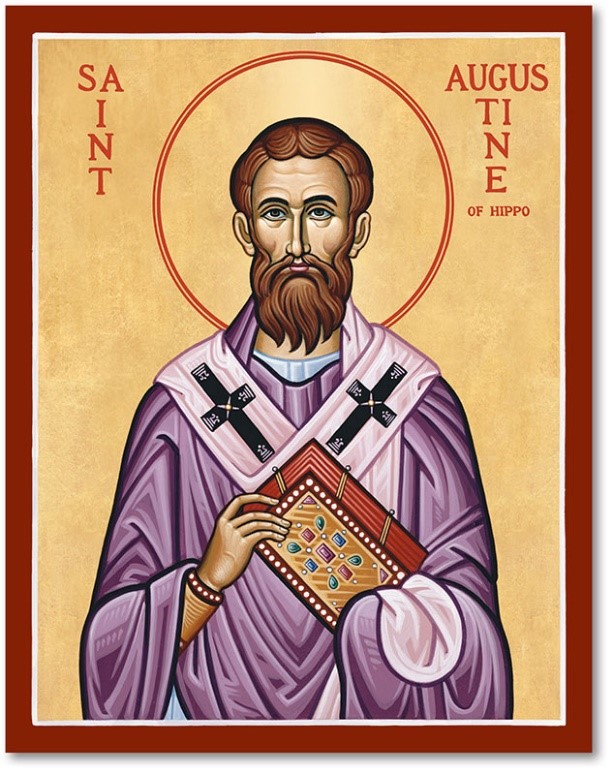
In my research, I have had to read quite a lot of one St. Augustine of Hippo, whose work has had such foundational importance in Western Christianity that his fingerprints can be found everywhere.
I hate that guy.
I know, it is very edgy of me to say that, right? What a hipster, what a posturing, preening academic! What hubris! To scoff at the work of the titanic theological presence of Augustine! Why, no less than Thomas Aquinas, Jean Calvin, Martin Luther, and John Wesley cite Augustine as such a foundational influence that much of their own theology springs from his roots! The sheer audacity of it all, etcetera and so forth.
My position merits some explanation. I do not say “hate” lightly. His worst rhetorical excesses pushed Christian theology to a radically toxic message, one that is hard to extricate from our doctrine. I did not come to this position in an offhand, uninformed way, though. I came to this position through research; many hours hunched over his work through years of academic study will allow one to form a kind of parasocial relationship with the philosophers of yore. My parasocial dynamic with Augustine of Hippo is that of villainy and antagonism.
If you have read Augustine, you have most likely read his Confessions, a book-long prayer telling of the life and exploits of a young saint. Augustine was notably distressed at the many sins he was guilty of in his youth, but it is a perspective that belies an underlying current of self-hatred. This self-hatred colors much of his work. Take, for example, the meditation in Book II of the Confessions, in which he relates his shame and regret at the impious act of… stealing a pear from someone else’s tree while he was out with his friends.
Behold my God, the lively recollection of my soul is laid bare before you—alone I had not committed that theft, wherein what I stole pleased me not, but rather the act of stealing; nor to have done it alone would I have liked so well, neither would I have done it… we are ashamed to be shameless…
(Confessions, Book 2, Chapters 9 and 10)
…Who can unravel that twisted and tangled knottiness? It is foul. I hate to reflect on it. I hate to look on it.
It is this act that he feels such burning shame for, that he compares all sin to the act of theft. Theft and acquisition of someone else’s property is thus the basis for his sinful heart. All sin is thus not predicated on simply doing evil for evil’s sake, but for some kind of ulterior desire for something material or concrete.
There is a desirableness in all beautiful bodies, and in gold, and silver, and all things; and in bodily contact sympathy is powerful and each other sense has his proper adaptation of body…
When therefore we inquire why a crime was committed, we do not believe it, unless it appear that there might have been the wish to obtain some of these which we designated meaner things, or else a fear of losing them. For truly they are beautiful and comely, although in comparison with those higher and celestial goods they be abject and contemptible. A man has murdered another; what was his motive? He desired his wife or his estate; or would steal to support himself; or he was afraid of losing something of the kind by him; or being injured, he was burning to be revenged…(Confessions, Book 2, Chapter 5)
So it seems that even Catiline himself loved not his own villainies, but something else, which gave him the motive for committing them.
So much of the Confessions reads like this, and this line of self-examination and self-hatred is steeped in a mountain of self-loathing and preoccupation with grief.
But I, wretched one, then loved to grieve, and sought out what to grieve at, as when, in another man’s misery, though reigned and counterfeited, that delivery of the actor best pleased me, and attracted me the most powerfully, which moved me to tears. What marvel was it that an unhappy sheep, straying from Your flock, and impatient of Your care, I became infected with a foul disease? And hence came my love of griefs — not such as should probe me too deeply, for I loved not to suffer such things as I loved to look upon, but such as, when hearing their fictions, should lightly affect the surface; upon which, like as with poisoned nails, followed burning, swelling, putrefaction, and horrible corruption. Such was my life! But was it life, O my God?
(Confessions, Book 3, Chapter 2)
I hypothesize that Augustine is focused on sin precisely because he is so overwhelmed by grace and forgiveness. He had a youth spent following his lusts and desires, and in his later days, he felt grief and shame over his behavior. This is not a bad thing, nor is it uncommon, especially among converted Christians. I doubt his work would have been nearly as impactful for audiences had he not lived these experiences and shared them in this way; a confession of sin can be moving, and inspiring for those who wish for some kind of absolution or salvation from their past mistakes. However, he had another love that made his self-shame so pernicious: His skill with rhetoric.
Augustine was a prolific writer and public speaker. In terms of classical rhetorical style, he was a master of the art of informing, persuading, and delighting those who hear him. His works in On the Trinity and The City of God are classics of Christian theology, foundational for much of the Western tradition, both Roman Catholic and Protestant. Even now going over my notes, I am struck by how well-crafted and intricate his arguments are, and how profound he can be. His place in our canon is earned, if not for the fact that he was particularly good at creating and explaining his theology.
This is where a lot of my research kicks in. My forthcoming doctoral dissertation is on the doctrine of the imago Dei, the Image of God, and how it needs a deconstruction/reconstruction. Why? Because of Augustine.
Augustine has a long legacy, and it is impossible and impractical to make a full account of his theology—better theologians have spent lifetimes doing that. No, my focus was on his anthropology. Our beliefs about humanity and how we were created, how we live, and where we ultimately will rest, are fundamental to our systematic theology. Theology affects action; what we believe informs how we act. For Augustine, I am afraid his theology has influenced quite a bit.
Augustine is notable for popularizing many key concepts, most notably Original Sin, whom he received from St. Paul and St. Cyprian, but expounded upon in a way wholly his. The condensed version of Original Sin is that since the fall of Adam in his sin against God and expulsion from Eden, humanity has passed down the inclination to sin as a kind of original STD. (I am obviously simplifying for our purposes here, and though it is not my focus, Original Sin is an important aspect of anthropological theology.) There are many ideas as to how this works, but for Augustine, it is this inherited state of sinfulness that has done humanity the most harm, and controversially, harm done to the imago Dei.
One can see this play out in his sermons most clearly; Original Sin is such defining feature of our existence that for Augustine, it can destroy or remove the Image of God that dwell within us.
Be satisfied with God as he is, not as you would like him to be. You are all twisted, and you want God to be like what you are, not what he is. But if you are satisfied with him as he is, then you will correct yourself and align your heart along that straight rule from which you are now all warped and twisted. Be satisfied with God as he is, love him as he is.
He doesn’t love you as you are, he hates you as you are. That’s why he is sorry for you, because he hates you as you are and wants to make you as you are not yet. Let him make you, I said, the sort of person you are not yet. What he did not promise you, you know, is to make you what he is. Oh yes, you shall be what he is, after a fashion, that is to say, an imitator of God like an image, but not the kind of image that the son is…
So too is the image of God in the creature is not what it is in the son who is what the Father is, that is, God the Word of God through which all things were made. Therefore receive the likeness of God, which you lost through evil deeds…(“Discourse of Saint Augustine on the Ten Strings of the Harp: Sermon Preached at Chusa,” The Works of Saint Augustine: Sermons, Ed. John E. Rotelle, trans. By Edmund Hill, NY City Press, pg. 267)
…God hates you as you are but loves you as he wants you to be, and that is why he urges you to change.
For Augustine, we have lost the original image of God as given to us upon our creation. That thing that draws us to God, and urges us to self-transcendence, is lost because of sin. We are thus malformed, misshapen creatures, without the connection to the divine, for something an ancestor of ours did that we have no control over. This is absolutely damaging, has harmed theology for centuries.
Think for a moment about how the idea that losing the thing you were created with forms you. It makes you see that there is a portion of the population that has the image, and some that do not. If you do not have it, you are thus lesser than the others. This can lead to all kinds of harmful ethics, up to and including ableism, sexism, and racism. You can see this in Aquinas in his understanding of women being lower in stature than men in creation. You can see this in Luther, taking this as a basis and increasing the intensity, calling humanity post-Adam “subhuman.” The effects this theology has had on the church is catastrophic and ongoing.
Oh, and that is not where it ends. You see, when he talks about the essence of humanity, it is in the combination of the divine image with the being of beasts; everything not godly is beastlike.
Take for example this piece from On the Trinity:
For as a snake does not creep on with open steps, but advances by the very minutest efforts of its several scales; so the slippery motion of falling away [from what is good] takes possession of the negligent only gradually, and beginning from a perverse desire for the likeness of God, arrives in the end at the likeness of beasts. Hence it is that being naked of their first garment, they earned by mortality coats of skins. For the true honor of man is the image and likeness of God, which is not preserved except it be in relation to Him by whom it is impressed. The less therefore that one loves what is one’s own, the more one cleaves to God. But through the desire of making trial of his own power, man by his own bidding falls down to himself as to a sort of intermediate grade. And so, while he wishes to be as God is, that is, under no one, he is thrust on, even from his own middle grade, by way of punishment, to that which is lowest, that is, to those things in which beasts delight: and thus, while his honor is the likeness of God, but his dishonor is the likeness of the beast, “Man being in honor abideth not: he is compared to the beasts that are foolish, and is made like to them.”
(On the Trinity (p. 374). Veritatis Splendor Publications. Kindle Edition.)
For Augustine, our existence as such is no more than punishment for our Original Sin, a sin which has been punished through generations of humanity since the very beginning. Humans, without intervention, are doomed. It is a severe theology, and though largely there is some merit to it, I find that it can easily be used as a weapon against the faithful rather than a guiding light towards salvation in Christ.
Oh, this might go without saying, but as a Roman male citizen from the 4th century AD, Augustine is very sexist and antisemitic. There are frankly too many examples to cite for antisemitism, and all his work is rife with it. But for our purposes here, we return to his understanding of the imago Dei and evidence of his low view of women. When he is trying to defend women, he states that they do in fact bear the image of God… but only when they are married to their husbands.
But we must notice how that which the apostle says, that not the woman but the man is the image of God, is not contrary to that which is written in Genesis, “God created man: in the image of God created He him; male and female created He them: and He blessed them.” For this text says that human nature itself, which is complete [only] in both sexes, was made in the image of God; and it does not separate the woman from the image of God which it signifies. For after saying that God made man in the image of God, “He created him,” it says, “male and female:” or at any rate, punctuating the words otherwise, “male and female created He them.” How then did the apostle tell us that the man is the image of God, and therefore he is forbidden to cover his head; but that the woman is not so, and therefore is commanded to cover hers? Unless, forsooth, according to that which I have said already, when I was treating of the nature of the human mind, that the woman together with her own husband is the image of God, so that that whole substance may be one image; but when she is referred separately to her quality of help-meet, which regards the woman herself alone, then she is not the image of God; but as regards the man alone, he is the image of God as fully and completely as when the woman too is joined with him in one.
(On the Trinity (pp. 367-368). Veritatis Splendor Publications. Kindle Edition.)
Or here, where he affirms that women’s salvation comes through bearing children:
For that the Apostle Paul, when speaking outwardly of the sex of male and female, figured the mystery of some more hidden truth, may be understood from this, that when he says in another place that she is a widow indeed who is desolate, without children and nephews, and yet that she ought to trust in God, and to continue in prayers night and day, he here indicates, that the woman having been brought into the transgression by being deceived, is brought to salvation by child-bearing; and then he has added, “If they continue in faith, and charity, and holiness, with sobriety.”
(On the Trinity (pp. 368-369). Veritatis Splendor Publications. Kindle Edition.)
Augustine reproduced the patriarchal norm of his culture through his theology, and because of that, it affected the growth and development of the church’s theology for centuries to come. Many of the policies and doctrines of modern institutional churches reproduce this language and these ideas, furthering the toxic effects of his work. His fingerprint is everywhere, and no student of theology or church history can truly escape the long shadow his work casts over us.
In fairness, there are things to like about Augustine. He is quite elegant in his words, a naturally gifted rhetorician, and his understanding of the Trinity is quite possibly one of the most elegant pieces of theology ever put to paper. However, that comes with a severe and self-hating theology that has lasted long past its due without thorough interrogation.
There is too much really to share in a humble blog post, honestly. One could spend a lifetime interrogating the work and impact of Augustine upon Christian theology, and I’m sure we all have more fruitful things to do with our time and more exciting projects to pursue. Additionally, if you don’t want to take my word for what he says, the good news is that pretty much everything he ever wrote is freely available online. You can look it all up yourselves. By all means, make your own conclusions after reading him.
As for me, Augustine is kind of terrible because beneath his writing is a deep sense of self-loathing, which he imputes onto all of humanity, and even denies humanity to human beings because of it. Though he is foundational for any student of theology or person interested in the history of faith, one ought not take his word as gospel; rather, as but a humble man, with gifts and flaws, just like the rest of us. Yet, nevertheless, in a refrain adapted from the site formerly known as Twitter:
If Augustine has a million haters, then I’m one of them.
If Augustine has one hater, then I’m THAT ONE.
If Augustine has no hater, that means I’m dead.


Leave a Reply to Kristian Powell, B.A. in Medieval StudiesCancel reply