
I recently had the opportunity to visit Texas for the first time. San Antonio, to be precise, for the annual meeting of the Society for Biblical Literature. As I was doing my research on places to see while I was there, I found frequent references to the Alamo. As an Australian, the limit of my knowledge of this place was having heard the phrase “Remember the Alamo!”
For those whose awareness of this part of history is similarly limited, the Alamo (originally named the Misión San Antonio de Valero) was a Spanish mission built to convert the indigenous people to Christianity. It is one of a number of missions in the city now called San Antonio, albeit probably the most famous.
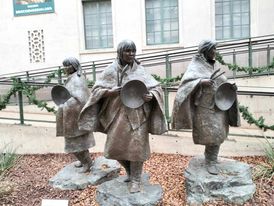
This mission is famous because some years after it was deco-mission-ed, it was the site of a siege and battle.1 It is still unclear to me who the players in this battle were, because the histories refer to Spanish, Mexican, Texian, Tejano and American people without defining clearly who each of these people are.2 There is limited acknowledgment or reference to the Payaya people of the Coahuiltecan nation and other native peoples of the area.3
At the battle of the Alamo, Mexicans defeated the Texians (as I understand it) and there were very few survivors.4 During the siege there were women and children who hid in what had been the sacristy. I did not know any of this history as I stepped into the ruins of what had been the church. But from the first moment, I could feel the pain this site contained. My feet tingled and my stomach clenched. Inside the sacristy, where the women and children sheltered the feeling of psychic pain intensified. During the short video presentation, I had to remind myself to breathe and afterwards I left fairly quickly to escape the tension.
In visiting some of the missions, I was aware of similar sensations although none were as powerful as at the Alamo. I had felt a similar sensation once before when I visited Willow Court, the site of a historic asylum in the Australian state of Tasmania. I was reminded of the verse in Luke where Jesus is reported as saying that “if these were silent, the stones would shout out” (Luke 19:40 NRSVUE).5 In Luke’s narrative this is just before Jesus weeps over Jerusalem.6 The sense in the text is that the stones will cry out in praise of Jesus as he makes his last triumphal entry into the city that he loved.
My heart says that if the stones can cry out in praise, then conversely, they must also be able to cry out in pain. My sense is that the stones at the Alamo (and at Willow Court) were crying out for anyone who is willing to witness the pain they have experienced. The blood that has been spilled. The lives that were violently taken. Not just in the famous battle, but also in the preceding years when the Spanish missionaries forcibly colonised the Indigenous people, in the name of the same Jesus who rode on the unassuming donkey, rather than in a conquering chariot.
I read on one of the signs that ‘Remember the Alamo’ is a rallying cry for Texans, spurring them on to victory. A victory of one more colonising people who are willing to use the tools of war to get their own way. As I think about what is happening in Gaza at the moment, I can’t help but think that ‘Remember the Alamo’ perhaps may serve as a reminder that the stones will remember the atrocities, long after there is no one left to name them.
- Davy Crockett also apparently died in this battle and his are bones interred in the cathedral, although there is conjecture about the historicity of this event and whether they are his bones or some other random victims. (https://www.history.com/news/10-things-you-may-not-know-about-davy-crockett). ↩︎
- Perhaps becuase none of these groups had clearly defined boudaries. History can be messy like that. ↩︎
- For more information see: https://www.thedoseum.org/exhibit-resources/posts/the-payaya-story. ↩︎
- This was not the last battle, and ultimately the Texians prevailed and declared the area the Republic of Texas.( https://www.thealamo.org/). ↩︎
- In my head I can hear the line as sung in ‘Hosanna‘ from Jesus Christ, Superstar. ↩︎
- Another song from Jesus Christ Superstar, that is particularly evocative at this time. ↩︎

Leave a Reply