
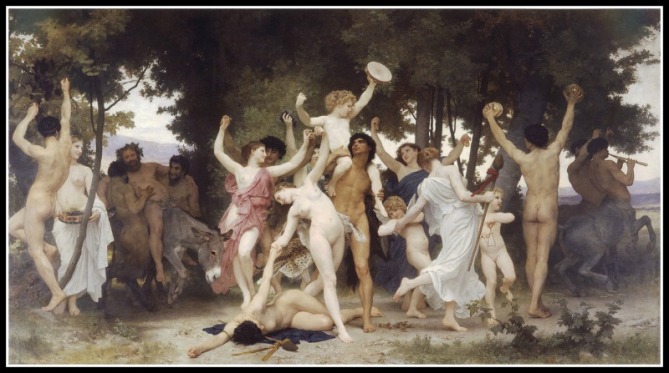
Lately I’ve been revisiting feminist discussions of the body, and thinking about the importance of the body for feminist politics in general. I was researching the religious origins of theatre for personal interest, and was surprised (although not completely shocked) to discover that theatre owes its origins to the Dionysian fertility cults. It’s interesting to think about what makes theatre distinct from the religious festival, but undoubtedly the role of an audience is key. The presence of an audience, at least a human one, instantly renders participation in any given ecstatic activity for that audience, so that performance eventually replaces immersive participation as the main objective of creative expression.
I suppose Dionysius and the gods would have watched as people danced and drank and sang at the original ceremonies, but the circumstances feel different in that they probably weren’t watching for the sake of entertainment alone. At this stage in human history, fertility cults maintained the socio-political order of the societies and communities that performed them, so they more or less had a sociological function. My point in mentioning this, besides being something I find really interesting, is that it’s one of many examples where a cultural activity with egalitarian or even predominately female origins gradually comes to exclude women altogether once it gets adapted into something else. Eventually, women were later banned from acting on stage (Allison has a fascinating piece about a similar history re: women’s role in brewing beer).
For me, there is something to notice about this evolution in moving away from the body and into the mind; art/theatre is certainly a more cerebral activity than the religious orgy, which is more closely associated with femininity, bodily fluids, movements, and outbursts (and thus inferiority). I’ve always wondered which of these things were primarily presumed to be inferior in Classical times: the physical body itself, womanhood as an existential category, emotion and irrationality, or something else. But this matters less, I think, than the fact that there’s a hierarchy here in the first place. This is a Western perspective to be sure, and probably a Western problem specifically. I wonder if contact with other cultures that hold women and the body in higher regard have led feminists to shift their priorities away from body politics, perhaps in a racist move to focus on more “contemporary” or “sophisticated” gender issues, or if the ongoing struggle for reproductive rights fixes our discussion of the body to the reproductive body (or maybe I’m imagining that the body has been cast aside as a major theme of feminism at all!).
Of course, the vehement transphobia circulating at every level of our culture has made the body a fraught subject, which is largely if not exclusively due to the fact that the female body is, again, equated to a strict set of reproductive organs. It always begins as a well-meaning alliance or association at first—a way of linking together ideas that help feminists discuss specific strains of sexist history or ideology—much of which does indeed pertain to lactation, menstruation, pregnancy and childbirth. But notably, the link between femininity and reproductive biology is one that misogynists have relied upon for centuries to oppress women. In any case, these associations can quickly devolve into constrictive reductions of those initial, provisional assumptions if we’re not careful. And yet, acknowledging how cis women’s bodies have been deployed as justification of their inferiority and exclusion from society is incontestable. I’m not sure it’s possible to emphasize enough how important the body is to feminist analysis and anti-patriarchal political projects. But the damage transphobia has done to the body’s analytic potential as a powerful, anti-sexist framework through which to view certain histories of misogyny is becoming more and more evident. Any supposed challenges trans women have made to “traditional” understandings of the female body should only expand what we consider women’s bodies to be.
I guess one of my issues with problematizing “biology” is that biology might not be the problem per se: the problem might be that our conception of biology remains stagnant, inflexible, or fixed to a narrow definition that promotes exclusion. These “othered” female bodies—trans, working class, differently abled, and more—all have an irrevocable relationship with human biology, and they have always been targets of patriarchal systems of violence. Instead of the “female” body, we might want to think about what a feminist body is, and what it must encompass to ensure liberation for all women. Expanding the meaning of the body beyond maternity or reproductive anatomy strikes at multiple, overlapping systems of oppression that go beyond sex-based oppression. It would open up our understanding of women’s bodies to include hands, skin, divergent minds, and genetic makeup, which ultimately brings us closer to critiques of classism, racism, ableism, and so on. In reality, there’s so much potential for body politics to become truly intersectional.
I’ve always loved 1 Corinthians 12 where Paul writes about different parts of the Christian body serving different purposes for the greater good of the body of Christ. If I were to add a faith perspective to this discussion, I think I might start here. “Just as a body, though one, has many parts, but all its many parts form one body, so it is with Christ” (v. 12). The rest of the chapter is a moving reflection on the necessity of every organ and limb of the body as a metaphor for the importance of maintaining harmony with other Christians when using spiritual gifts. As Paul explains, it would be nonsensical for each “part” (i.e. person) of Christ’s body to claim that they don’t belong to it because they are not some other part of the body: “if the foot should say, ‘Because I am not a hand, I do not belong to the body,’ it would not for that reason stop being part of the body. And if the ear should say, ‘Because I am not an eye, I do not belong to the body,’ it would not for that reason stop being part of the body” (vv. 15-16).
What I love about this passage is that it dismantles that feeling of not belonging somewhere simply because you don’t conform to a way of being that other people say is better or “right.” It goes beyond a superficial embrace of unity and stresses the importance of difference in both achieving and maintaining that overall sense of unity. In the ancient Greek Dionysian cults, physical sensuality, intoxication, and bodily possession are crucial goals of the ceremony, even though fertility was their raison d’être. Body politics feels more necessary than ever, and my hope is that our encounters with gatekeeping, violence, and division actually become occasions to affirm a complex understanding of the body, as well as the legitimacy of multiple types of bodies, and how essential they are to the definition of both womanhood and the feminist body.


Leave a Reply to Jessica PegisCancel reply