
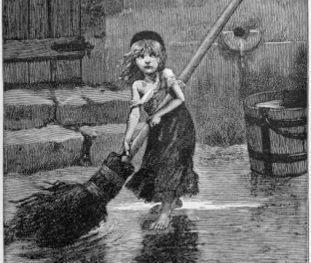
One year ago on Christmas a miraculous event took place. On 25 December 2012, the movie adaptation of the English-language version of the musical Les Misérables was released. For someone who is as much a Francophile as I am, this was a momentous occasion, though my love affair with the musical actually comes from when my grandfather took me to see the stage production back when I was in the first grade. Having since become an academic, the one-year anniversary of the release of the movie has given me an opportunity to reflect on the theology portrayed in the musical’s characters.
After re-watching the film, there is so much that I want to say about it (candlesticks!), but in particular the character of Inspector Javert caught my attention. Though I doubt Cameron Mackintosh, who created the English-language version of the musical, knew anything about my present area of research, Jansenism, it is uncanny how Jansenist Javert’s theological anthropology appears. Jansenism was a religious movement in early modern France, thriving especially in the seventeenth and eighteenth centuries. Today, scholars characterize it by its heavily Augustinian theology of grace and its rigorism in sacramental practices. Of course, Jansenists themselves denied the existence of any so-called heresy, asserting their orthodoxy through Augustine.
In terms of theological anthropology, alleged Jansenists had a pretty negative view of human ability, emphasizing especially the sinful nature of humanity. For example, the abbess of the convent of Port-Royal, Angélique Arnauld (1591-1661), repeatedly emphasizes her tendencies toward sin, especially pride, in her letters to Jeanne de Chantal (1572-1641). For example, her 9 November 1637 letter states:
I am miserable from the continuation of my infidelities and resistance to [God’s] grace. I cannot fully express to you what I am suffering… I believe that my whole life is only lies and hypocrisy. With this I have a fear of God which is servile and horrible and such an apprehension of death and of hell that it seems that I have no love [for God], nor true confidence in him. All my prayers and actions appear… to be only products of human spirit…, not of grace.
Jansenists emphasized the inability of humans to contribute anything to their salvation. In her letters Angélique frequently requests prayers for herself so that God might overcome her will and end her resistance to his grace. In the same letter she says, “I beg you, my very dear mother, pray to God that he might have pity on me and destroy in me all opposition… to his grace… It seems I have a great need to be humbled and overcome… [But] God will make what he needs out of me, and will do so despite me.”
So, returning to Javert, some of these same themes appear in his songs. For example, his part in the confrontation with Jean Valjean begins, “Men like me can never change. Men like you can never change,” which, like the Jansenists, emphasizes the inability of human beings to overcome their own innate (sinful) tendencies. (Though I will note that this seems to be contradicted later by “Every man must choose his way.”) In the same song, he also notes that “Every man is born in sin,” highlighting a negative view of the human condition.
His negative theological anthropology appears most in his song “Stars,” which begins, “There, out in the darkness, a fugitive running, fallen from God, fallen from grace.” His view is that once fallen, human beings are unable to find redemption. We do not even get the sense that those who have fallen can be redeemed by God, as Angélique believed. He continues, “And those who follow the path of the righteous shall have their reward. And if they fall as Lucifer fell, the flames, the sword!” and, “So it must be and so it is written on the doorway to paradise that those who falter and those who fall must pay the price.” Here, it is not only those who have fallen that will be unable to reach paradise, but even those who merely falter in their ways. There is not much room for hope in Javert’s theological anthropology.
Javert represents the adversary in Les Misérables. Isabel Roche explains in her study of the different character types that appear in Victor Hugo’s novels what makes a character the adversary, saying, “These characters, most of whom fulfill the narrative role of the hero’s adversary and in whom the archetypal qualities of good and evil are both clearly outlined and at odds, are most often faced with a dilemma, or undergo a crisis or moment of possible conversion (spiritual, ideological, moral) that causes their internal antithetical extremes to either explode or implode, resulting often in their deaths” (Roche, Character and Meaning in the Novels of Victor Hugo, 83). Javert’s crisis occurs when Valjean saves his life at the barricade. He is unable to reconcile with his belief system the idea that the “fallen” Valjean that he knew in prison could have redeemed himself and this leads ultimately to Javert’s suicide. He does not believe that humans can change their sinful ways and the selfless act of Valjean in saving his life destroys his worldview. In the musical, this is expressed in song:
And my thoughts fly apart. Can this man be believed? Shall his sins be forgiven? Shall his crimes be reprieved? And must I now begin to doubt, who never doubted all these years? My heart is stone and still it trembles. The world I have known is lost in shadow. Is he from heaven or from hell? And does he know that granting me my life today, this man has killed me even so?
I suggest watching the video for Javert’s suicide after watching the above video from stars. The movie does an excellent job at paralleling the imagery of the two scenes.
Now, again, I doubt that Mackintosh had Jansenist theology in mind while adapting the character of Javert for the English-language audience, but could Victor Hugo (1802-1885) have had Jansenism in mind when creating the character? Here’s where an interesting coincidence of history comes in. Hugo was friends with Charles-Augustin Sainte-Beuve (1804-1869). Sainte-Beuve is the author of the iconic (among scholars of Jansenism at least) Port-Royal, a romantic literary history of the convent of Port-Royal, where Angélique was abbess. So, is Javert meant to represent a Jansenist theological anthropology? I’d say it’s possible.


Leave a Reply to emmasrandomthoughtsCancel reply