
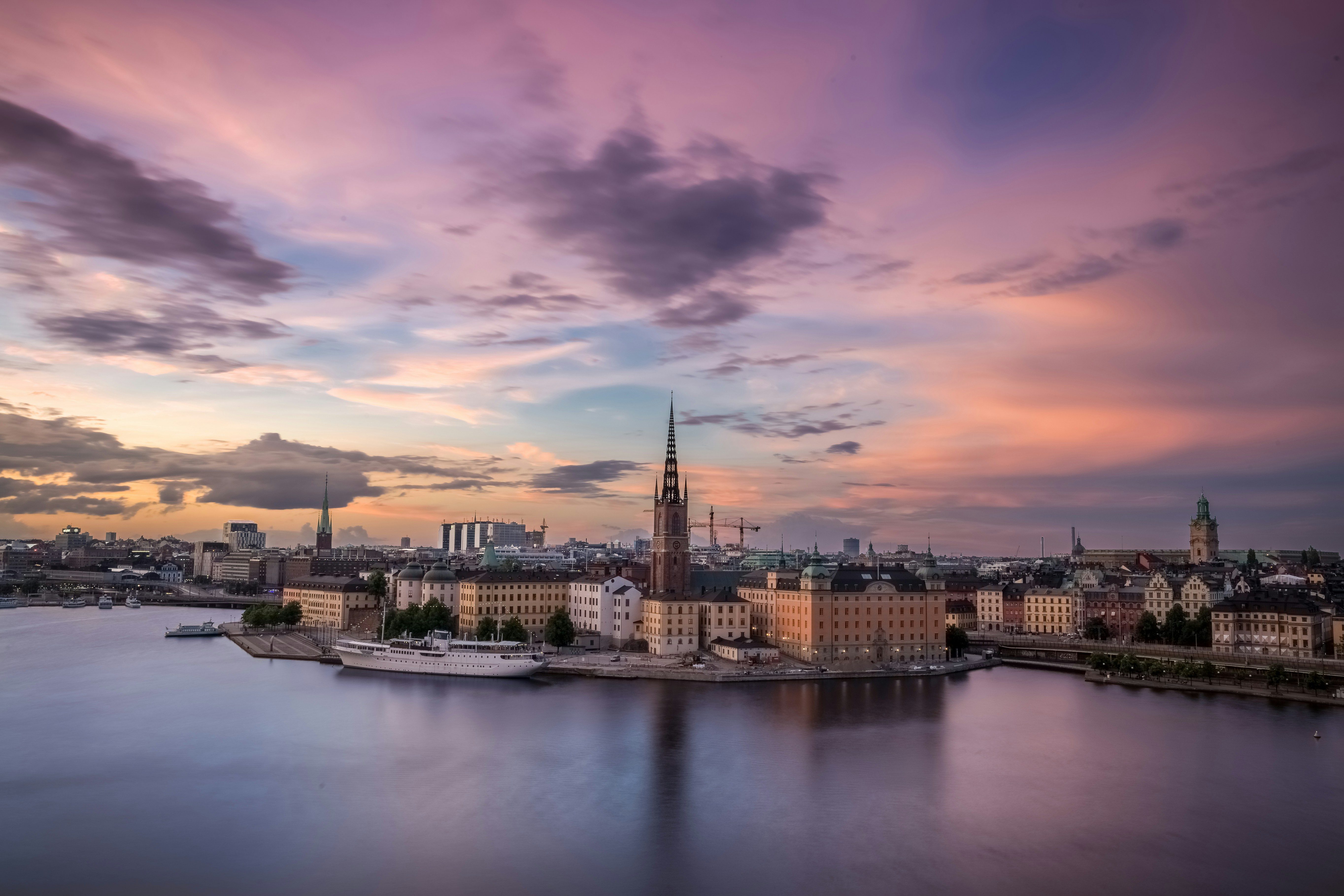
The Cambridge Dictionary defines secular as “not having any connection to religion.” But in its colloquial use in post-secular Sweden, secular has become a category that bears much more than this, symbolizing ideals such as equality, autonomy, openness, and freedom of conscience. These ideals were shaped across Nordic contexts deeply impacted by centuries of Christian institutional dominance. And the shifting connotations have also been noted by academic and public actors (Sanna 2015; Rana 2008). Language used to describe society moves within a historical horizon just as society does. In a rapidly changing world like ours, the meaning of categories shifts fast as well.
In a video series Is Sweden the World’s Most Secular or the World’s Most Christian Country? (2016), Ulf Lindgren, a priest in the Church of Sweden, challenges the phrase often used in mass media, “Sweden is the most secular country in the world.” The videos are only available in Swedish. He notes that the meaning of secular began to change with major cultural and political shifts in the 1700s, namely, the Renaissance and the Enlightenment. Interestingly in early medieval Christianity, a “secular priest” meant a diocesan priest who lives and serves in the world (saeculo) unlike a “religious priest” who belongs to the monastic life and religious order. The Vatican still uses these terms today.
When public reports highlight Sweden’s extreme secularization, what they imply is not only the decline in religiosity, but also its relation to the religious past and comparison to other nations that share the past where the Church was their government. Furthermore, in the global context, the genealogy of secularism becomes more complex. Regions such as East Asia, for example, never experienced the centralized dominance of an institutionalized state church that shaped governing power across Europe and in Ethiopia. Religious traditions such as Confucianism, Buddhism, Shinto, and more recently, political religion have certainly influenced governance in East Asia, but their influences were episodic and far shorter than nearly millennia-long, nationwide authority of the Western state churches. This reveals the unique historical setting in which post-secular European worldviews emerged.
One of the most frequently referenced sources on secularism in Sweden is the World Values Survey (WVS), a global decentralized interdisciplinary research in political science and sociology. WVS (2023) employs Inglehart-Welzel’s cultural map method, first published in 1997. To offer a broad map of values by nation, it juxtaposes the following analytical categories:

- X-axis: Survival ↔ Self-expression values
- Y-axis: Traditional ↔Secular-rational values
Although the Y-axis is visually labeled simply as “Traditional ↔ Secular” in the cultural map, Inglehart and Welzel consistently refer to the upper end of the Y-axis in their synthesis as “secular-rational values.” This typological expansion embeds a normative association between being rational and being secular that it reframes how national value orientations are interpreted.
According to WVS’s cultural map (2023) above, countries that present the highest level of secular-rational values are East Asian societies like Japan, South Korea, and Hong Kong. Sweden stands out for exceptionally high self-expression values and also very high secular-rational values. With this in mind, let’s take a closer look at what Inglehart and Welzel mean by “secular” and “traditional.” The categories used for synthesizing national values on the Y-axis are defined as follows:
- Traditional values: high emphasis on religion, authority, and conventional family structure.
- Secular-rational values: greater acceptance of practices like divorce, abortion, euthanasia, and gender equality, less emphasis on religion and authority.
The definitions above encode moral differences while leaving their genealogy of meaning and historical shifts largely unaddressed. They are also difficult to apply unproblematically in post-secular Sweden because many churches including the majority church, the Church of Sweden, have themselves come to accept divorce and gender equality, while adopting more differentiated ethical positions on abortion and euthanasia over the last century. Such developments shift the meaning of “traditional values” in Sweden by generating new norms and traditions, reflected both in ecclesial practice and in broader social attitudes.
A comparative perspective further complicates the typology. While “traditional” may be read as synonymous with “religious” in European settings shaped by centuries of Christian institutional dominance, in much of East Asia Christianity expanded primarily in the modern period particularly from the late 19th century onward. In this sense, Christian practices in this region cannot easily be classified as “traditional,” but rather emerged as part of processes of modernization. Moreover, religious traditions that are locally considered “traditional” do not necessarily share the pre-secular European Christian views on issues like divorce, abortion, and euthanasia while gender equality was never understood as realization of justice.
In the book, Modernization, Cultural Change, and Democracy (2005), Inglehart and Welzel situate their cultural map method within modernity: a post-Enlightenment intellectual tradition that treats secularization and rationalization as indicators of developmental progress. Analyzing this framework from a contemporary Swedish context, I find that this framing further raises the question of why “secular” is paired with “rational,” while “traditional” is not given a corresponding modifier. It is unclear to me whether the term “secular” in this framework refers to irreligiosity in its modern lexical sense, or to the rational orientation of individuals and/or governing systems. While “traditional” may plausibly be read as “religious” in early modern Europe, the applicability of this distinction becomes less straightforward in post-secular Swedish contexts.
I am not suggesting that the cultural map requires different categories. Rather, the problem lies in reception: how its synthesis and typology are interpreted across contexts. As categories of value are not fixed in character but are constituted and re-constituted through practice, especially in discourse (Fairclough 2013), what the cultural map identified as “secular–rational values” in 1997 may not correspond to what Swedes today, the religious and the non-religious alike, mean when they describe something as secular. Nor does “secular” necessarily carry the same meaning across Scandinavian, East Asian, African, or American contexts because religious practices and social imaginaries continue to shift. Additionally, if time is taken into consideration, it reveals further differences between generations in how “secular” is understood and lived. As Judith Butler reminds us, “Categories change meaning in time” (Butler 2025). This illustrates how practice over time generates the typological tensions embedded in the Inglehart–Welzel cultural map.
Categories of Practice vs. Categories of Analysis
To clarify this tension, I draw on Pierre Bourdieu’s account of practice and objectification in The Logic of Practice (1990), and heuristically distinguish between:
- Categories of practice: malleable and unstable (emic categories through which people perceive and navigate the social world.)
- Categories of analysis: objectifying and provisional (etic categories that are institutionally produced to make sense of practice.)
Here, “provisional” means that analytical categories are historically and socially situated tools. They are useful for interpretation but not fixed or universally valid descriptions of practice. By “objectifying,” Bourdieu refers to the act of making social practice an object of analysis, not a claim to objective or universally valid truth. The problem arises when these objectifying categories are treated as fixed and objective descriptions of social reality, rather than as provisional analytical tools shaped by specific historical and institutional context. Within the post-secular Nordic public discourse, the term “secular” has come to symbolize ideals such as religious freedom, social progress, resistance to oppression, equality, and openness toward pluralism and inclusion. It denotes less a rejection of religiosity and more a representation of these ideals.
During the late 20th century, the certainty of secularization theory in Europe made the term appear objective and universal, as though it could function as objective analytic tools. When the Inglehart–Welzel cultural map was introduced in 1997, it treated these culturally constituted terms as if they were fixed values across societies. However, as the map circulated, public/religious/political discourse adopted them, giving them new connotations that diverge from the original definitions that Inglehart and Welzel intended nearly 30 years ago.
As Sweden evolved into a post-secular society, the categories revealed their provisional nature. This dynamic reflects precisely the methodological risk Bourdieu warned:
“It also took me a long time to understand that the logic of practice can only be grasped through constructs which destroy it as such, so long as one fails to consider the nature, or rather the effects, of instruments of objectification such as genealogies, diagrams, synoptic tables, maps, etc.… and that they become false and dangerous as soon as they are treated as the real principles of practices…” (Bourdieu 1990)
He cautions against confusing analytical concepts used to objectify practice and lived experience with the principles that produce them.
The Western Genealogy of Secularism
“A major motive of secularism has clearly been the desire to end cruelties—the deliberate infliction in this world of pain to the living body of others, and the causing of distress to their minds—that religion has so often initiated and justified. Only a secular legal constitution (so it is argued) can restrain, if not eliminate altogether, religious violence and intolerance toward religious minorities.” (Asad 2003)
Talal Asad points out that secularism has been treated as a political logic universally applicable to non-Christian societies, although it is historically rooted in the Western Christian contexts shaped by the legacy of confessional violence and religious wars.

According to Pew Research Center’s Global Attitudes Survey (2024), Italy is most rapidly secularizing country, followed by Germany, Spain, and Sweden. Countries with the largest disaffiliation from the religion they were raised in by far is South Korea 50%, followed by Spain 40%, Canada 38%, and Sweden 37%.

Meanwhile, the Atlas of European Values (2022) shows that since 1990, the importance of religion has risen more than 30% in Bulgaria and also slightly risen in Sweden, ranked at 7th out of 22 European countries.
For attendance of religious services, Sweden showed the 5th lowest after Denmark, Iceland, Finland, and Estonia.
Nonetheless, many Swedes still choose to marry in medieval churches belonging to the Church of Sweden, highly valued cultural heritage, and baptize their children with or without religious significance. In this way, major passages of life continue to be celebrated through Christian traditions, even though participants may personally experience them as irreligious customs. This illustrates that fixed analytic categories of secularism struggle to account for lived practice over time (Davie 2000).

The categories through which societies are named inform how responsibility, authority, and moral meaning are understood within historically inherited trajectories. Therefore, attending to shifting categories like “secular” reveals how Christian frameworks continue to inform public life across the world.
The reflections in this text were formed within my belief that the innate dignity of every human being precedes all our categories, and that the ways we interpret and inhabit the world are relational, contextual, and not easily boxed into fixed typologies. In addition, I have explored contemporary Christian nationalist discourse in a previous post through a cosmopolitan lens, focusing on how categories of ethnicity, race, and nationhood are mobilized as fixed classifications of belonging.
Asad, T. (2003). Formations of the secular: Christianity, Islam, Modernity. Stanford: Stanford University Press.
Bourdieu, Pierre. (1990). The logic of practice. Stanford: Stanford University Press.
Butler, J. (2025). Judith Butler on Gender. The British Academy. Available at: https://youtu.be/MEvHJbGIcIw?si=ahwm6FS2ALA47KfE [Accessed December 10, 2025].
Cambridge University Press. Secular, in Cambridge Dictionary. Available at: https://dictionary.cambridge.org/dictionary/english/secular [Accessed: 4 December 2025].
Church of Sweden. (2021) Abort [Abortion]. Available at: https://www.svenskakyrkan.se/abort [Accessed: 15 December 2025].
Church of Sweden. (2025) Dödshjälp [Euthanasia]. Available at: https://www.svenskakyrkan.se/dodshjalp [Accessed: 15 December 2025].
Church of Sweden. (2022). Position Paper on Sexual and Reproductive Health and Rights (SRHR). https://www.svenskakyrkan.se/filer/130cd3e9-800e-4fdc-9cac-73734515ed18.pdf?id=1095498.
Davie, G. (2000). Religion in Modern Europe: A Memory Mutates. Oxford: Oxford University Press.
Fairclough, N. (2013). Critical discourse analysis: the critical study of language. London: Routledge.
Halman, L., Reeskens, T., Sieben, I. & van Zundert, M. (2022). Atlas of European Values: Change and Continuity in Turbulent Times. European Values Series, Tilburg University. Available at: https://assets.pubpub.org/0k7l6nt3/51652084537989.pdf [Accessed: 4 December 2025].
Lesage, K., Starr, K.J. and Miner, W. (2025). Around the world, many people are leaving their childhood religions. Pew Research Center, 26 March. Available at: https://www.pewresearch.org/religion/2025/03/26/around-the-world-many-people-are-leaving-their-childhood-religions/ [Accessed: 4 December 2025].
Lindgren, U. (2023). ‘Är Sverige världens mest sekulara eller mest kristna land? [Is Sweden the World’s Most Secular or the World’s Most Christian Country?],’ Svenska kyrkan, 16 September. Available at: https://www.svenskakyrkan.se/stockholmsdomkyrkoforsamling/ar-sverige-varlden-mest-sekulara-eller-mest-kristna-land [Accessed: 9 December 2025].
Rana, M.U. (2008). ‘Den sekulære ekstremismen’, Aftenposten, 25 February. Available at: https://www.aftenposten.no/meninger/kronikk/i/04016/den-sekulaere-ekstremismen [Accessed: 6 December 2025].
Sanner, I. (2015). ‘Sverige inte så sekulariserat som vi tror [Sweden Not as Secularized as We Think],’ Respons, 24 August. Available at: https://tidskriftenrespons.se/artikel/sverige-inte-sa-sekulariserat-som-vi-tror/ [Accessed: 6 December 2025].
The Local. (2016). ‘Sweden is the most extreme country in the world’, The Local, 19 July. Available at: https://www.thelocal.se/20160719/sweden-is-the-most-extreme-country-in-the-world [Accessed: 9 December 2025].
Tulloch, J. (2024). Pope: Secularity and missionary priests’, Vatican News, January 11, 2024. Available at: https://www.vaticannews.va/en/pope/news/2024-01/pope-secular-institute-of-missionary-priests-secularity.html [Accessed: 9 December 2025].
World Values Survey Association. (2023). World Values Survey Cultural Map 2023. Madrid: World Values Survey. https://www.worldvaluessurvey.org/WVSContents.jsp.

Leave a Reply