
I was very excited this year when several publishers reached out to me because of my earlier post reviewing Sue Monk Kidd’s The Book of Longings, saying that they had books by other authors who were similarly reimaging New Testament stories from the perspective of women characters. This, therefore, is the first of several posts in which I will be reviewing and analyzing these books.
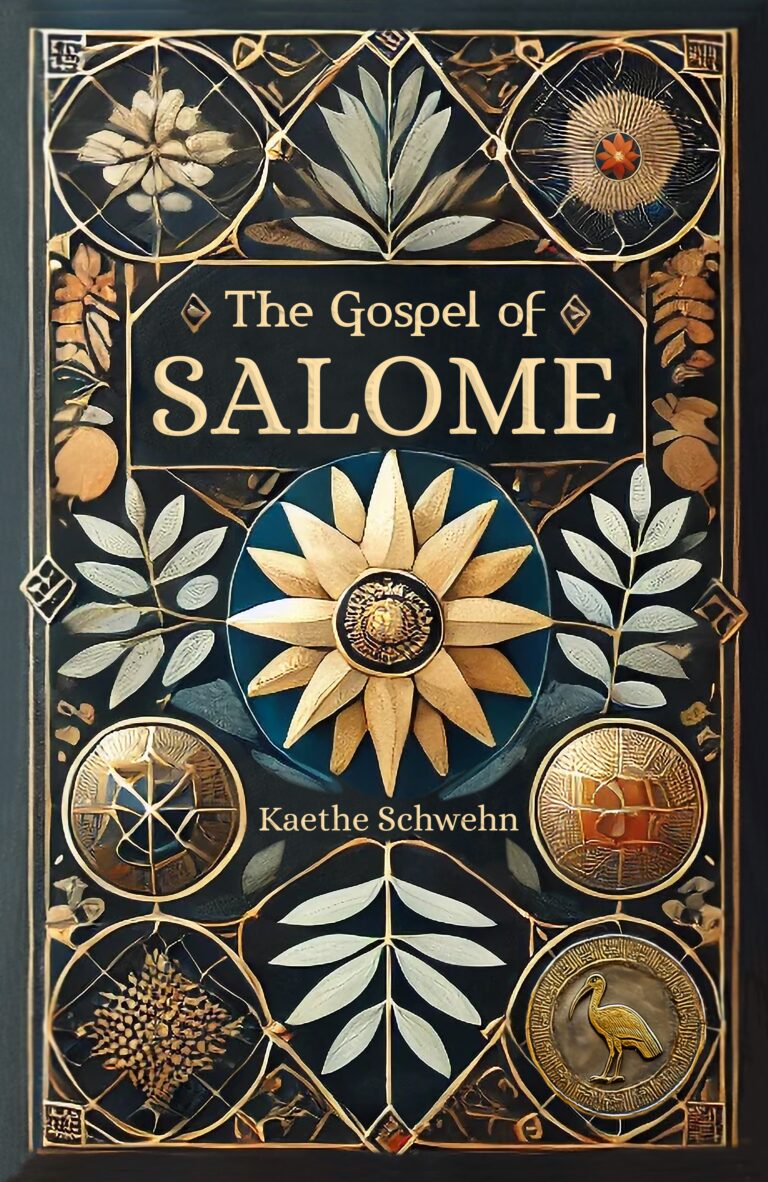
I recently finished reading The Gospel of Salome by Kaethe Schwehn (Wildhouse Fiction, 2025), which is a reimaging of the story of Jesus from the perspective of Salome, a character who is only mentioned at the end of the Gospel of Mark:
There were also women looking on from a distance. Among them were Mary Magdalene, Mary the mother of the younger James and of Joses, and Salome. These women had followed him when he was in Galilee and ministered to him. There were also many other women who had come up with him to Jerusalem. (Mark 15:40–41)
When the sabbath was over, Mary Magdalene, Mary, the mother of James, and Salome bought spices so that they might go and anoint him. (Mark 16:1)
What Schwehn has done in this book is to drastically reimagine Jesus’ story and insert Salome into it for his whole childhood, up until the start of his public ministry. Needless to say, in what I am going to write, be warned that spoilers will appear.

This book is primarily the story of Salome. In the author’s note at the end of the book, Schwehn describes her practice of writing in a way that echoes the Ignatian practice of imaginative prayer. She explains:
The actual language of the Bible offers only faint outlines of the dramatic events; usually, we are not given motivations or intentions or regrets, the scents of synagogues or the dialogue spoken by minor characters. Part of my own faith has always been imagining my way into these stories, not because I think my own mind can fill in the truth of what happened but because I long to live inside those moments in a way that the given language of the stories does not permit. (p. 309)
In the Spiritual Exercises, St. Ignatius asks for a similar exercise: to imagine the scenes in the Gospels, to imaging seeing the people as though present there, and to contemplate their words and their experiences. Schwehn has used this practice as a means for creating the story of the character of Salome.
I had the opportunity to ask Schwehn what her motivation and inspiration was to write this book, and she told me that she began by wondering if the source that scholars identify as “Q” was written by a woman. For those who might not be familiar with this source, scholars posit its existence because there are teachings by Jesus that appear in the Gospels of both Matthew and Luke, but not Mark. Thus, the argument is that the authors of Matthew and Luke used both Mark and Q as sources for writing their Gospels. As she started researching and writing, and as she also explained in this interview with Living Lutheran, “A woman emerged in my writing, but it turned out she wasn’t Q, she was Salome.”
This book is thus primarily the story of Salome, starting with her childhood in Greece, then jumping forward to her life in Alexandria in 38 CE during the Alexandrian riots—riots against Jews in Alexandria that were written about by Philo of Alexandria (who is also a character in this book). At this point, Salome is a healer, working at a clinic, who is asked by Philo to come help in the Jewish quarter of the city. She is also living—somewhat platonically—with Asha, a wigmaker and transwoman, of whom we get part of her story later in the book. It is at this point that she meets John Mark, who has come from Jerusalem to preach in the synagogue, but finds that he struggles with his words and is better at writing. He came to find Salome because “Mari, Yeshua’s mother, said you were here” (p.43).
At this point, the story alternates between the experience of the Jews leading up to and during the Alexandrian riots and Salome recounting her story to John Mark. John Mark then transcribes everything that Salome recounts to him.
The key change in the Gospel narratives that Schwehn makes is that Salome, not Mari, is the mother of Yeshua. He also has a human father, though we do not find out who that is until toward the end of the story. Yeshua is born “in the Mareotic community…, a handful of hovels cobbled together on a ridge outside of Alexandria, pressed between Lake Mareotis and the sea” (p. 61). She has trouble, however, breastfeeding Yeshua who is, at this point, “saved” by Mari (p. 63). Mari and Josef arrive at the community and encounter Salome—Mari has just lost her child and is able to breastfeed Yeshua and save his life. Thus, Salome allows Mari and Josef to “adopt” Yeshua and raise him in Nazareth, but Salome—unable to fully give up her child—comes to live nearby them. She is thus with Yeshua as he grows up and teaches him to heal as she had been trained. There is some tension throughout all this between Salome and Mari, as Mari does not want her son to become a healer, but is teaching him the Jewish scriptures.
I asked Schwehn about the characters of Mari, Josef, and Asha in part because I found Mari especially and Josef in some ways to be very unlikable characters. Mari fits every stereotype as the “overbearing, over-involved, suffocating Jewish mother” (see Myrna Hant, “A History of Jewish Mothers on Television: Decoding the Tenacious Stereotype,” Journal of Interdisciplinary Feminist Thought 5, no. 1 (2011): https://digitalcommons.salve.edu/jift/vol5/iss1/3). Josef ends up being torn between Mari and Salome, while Asha played such a small role in the story that I wondered why she was even there. Schwehn explained:
Ultimately, I think secondary characters work best when they help us see parts of the protagonist more clearly. Mari feels things deeply; she isn’t afraid of emotions and Salome abhors emotional displays, especially her own. Josef is gentle and nurturing and patient. Salome struggles deeply with how to nurture Yeshua on her own terms. Asha is comfortable with vulnerability, with her own story. She’s ready to love openly and without fear. Salome has a long way to go on that front. So although all three of these secondary characters have their own flaws and complexity, many of their attributes represent parts of Salome that are not yet fully developed. (Correspondence with author)
In that sense, I can see the justification for including these characters, and especially for giving them these characteristics that seem so counterintuitive to someone familiar with the Gospel narratives about Jesus.
As I noted previously, in this story Yeshua has a human father. Thus, while Schwehn does include parts of Jesus’ ministry—especially the baptism and the crucifixion—whether Yeshua is divine (whether through some form of adoptionism, or fate) is left ambiguous. Schwehn indicated through correspondence that she wanted to focus on the historical, so this theological question is left for the reader to decide. For example, Salome goes with Yeshua to see an unnamed prophet, who represents John the Baptist in the Gospel narratives, and something goes wrong—the prophet is with Yeshua in the river, and he has severe abdominal pain. “A squatting child pointed and yelled, ‘What’s inside that man?’ and then looked up expectantly. ‘A demon, perhaps,’ said a man with a halo of red skin around his neck” (p. 162). Salome guides Yeshua in the healing process that she had taught him—guiding him to push whichever internal organ is causing a lump back into place.
Then there was the prophet’s burnt-cedar scream into my ear. Yeshua’s voice so loud I could feel it at the base of my own lungs: “Be gone!” And then a distant sound like thunder passed overhead, the timbre of my own son’s voice galloping across the arc of blue. Then the prophet became soft dough beneath me, panting, eyelids quivering.
I peeled my own body upright again and looked at Yeshua. His hands were not against the torso of the prophet but raised, thrown back into the air as though to show he meant no harm. (p. 164)
At this point, the prophet baptizes Yeshua, and Salome comments, “I knew who my son was. But I knew they would tell it otherwise. And judging by the way his eyes refused to open, Yeshua already believed the story they would tell” (p. 165). Many of the incidents with Yeshua are told in this way—Salome is skeptical about it all, but it does leave the possibility for the miraculous occurring as well. In this instance, was Yeshua putting on a show for the crowd to step into the place as a new prophet—using his knowledge of healing to make the crowd think a miracle had occurred? Or was there divine intervention through the person of Yeshua to heal the prophet and indicate his position as God’s new prophet?
At the same time as I was reading this book, I was reading commentary on Mark’s Gospel because I had assigned that text to my honors class to read—the lesson that day was focusing on the way Jesus is described at the beginning of Hebrews and in Pascal’s Pensées, but I had wanted the students to have an overview of the story of Jesus in their mind during this. While the Gospel of Mark—like all the Gospels—was written anonymously, in the patristic era the author was identified as John Mark who is referenced in the Acts of the Apostles and some of Paul’s letters as the cousin of Barnabas and one who accompanied Paul and Barnabas at times during their travels. The Gospel was ascribed to one who interpreted Peter’s teachings—and in The Gospel of Salome it is “Peter the First” who sends out John Mark to preach (side note: it bothered me that she used “Peter the First,” because you cannot have a first without a second). One of the characteristics of Mark’s Gospel is, of course, the “messianic secret,” and Jesus shows genuine human emotion—in that sense, having John Mark as the one recording Salome’s story of the human Jesus (and leaving his divinity ambiguous) makes perfect sense.
Overall, I enjoyed reading this. It did take me a little while to get into the story, but once I did, I was interested to find out how Schwehn would have everything in Yeshua’s life play out in relation to Salome. I would recommend this to those who like the genre of biblical fiction, but not, obviously, if you might be bothered by the reinventing of Yeshua’s story in relation to Salome.

Leave a Reply