
Do not conform yourselves to the standards of this world, but let God transform you inwardly by a complete change of your mind. Then you will be able to know the will of God—what is good and is pleasing to him and is perfect.
Romans 12:2 (GNT)
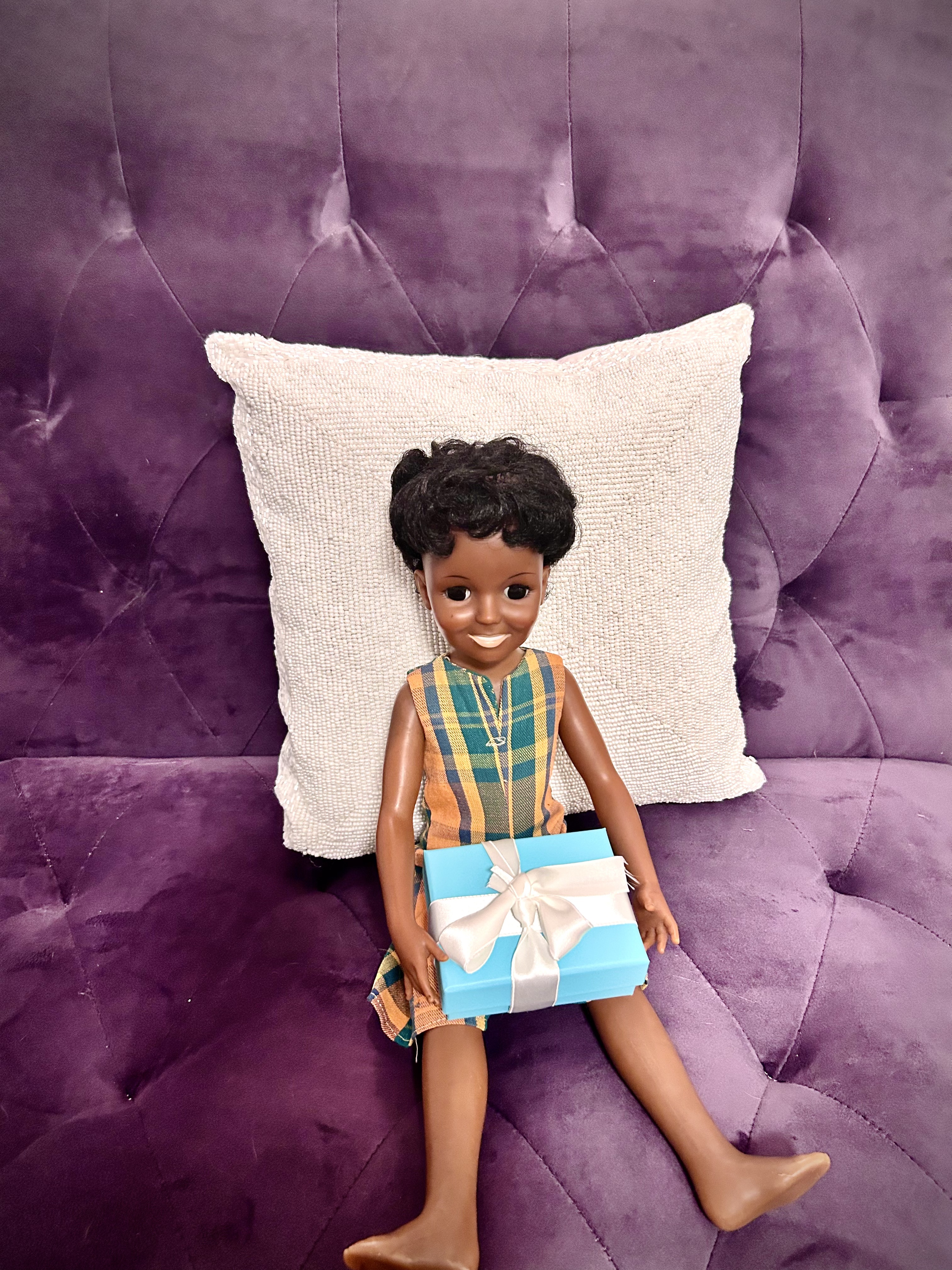
She’s a mini version of me. So, I pulled her hair out.
She’s not Barbie. She is Beautiful Crissy.1 Black Beautiful Crissy. She’s only 18 inches tall but she’s thin with big, beautiful dark brown eyes that close – like mine; deep, beautiful caramel colored skin – like mine; a captivating, beautiful smile with pearly white teeth – like mine; and beautiful, black hair – like mine. What makes Beautiful Crissy the doll that all the little girls wanted was what the television commercial told us. It stated that “everyone know that beautiful hair makes a girl look beautiful.”2 Beautiful Crissy had “beautiful hair that grows.” She wore a ponytail. If you press her belly button and pull on the ponytail, it grew longer down to just below her waist – not like mine.
I received Beautiful Crissy one Christmas in the early 1970s. Before her, my favorite doll was a 24-inch tall, white Dancerina Ballerina doll.3 This doll wore a hot pink leotard and tutu with a pink plastic crown on top of her blonde pony tailed hair. When you pushed in her crown, she danced – pirouetting on the tips of her toes in light pink pointe shoes. She was fun to play with but there were three problems with her. Her clothes were attached to her, which meant that she was always a ballerina. She was thick and bulky, which made her hard for my little arms to carry. She also didn’t do anything like me, which especially meant that she didn’t look like me. After numerous pirouettes, I stopped playing with Dancerina. I don’t know whatever happened to her.
Crissy is different. She became my instant favorite and more than a toy. I didn’t just play with Crissy, I lived with Crissy. When I talked to her, I believed she understood me because she was my friend. I took her with me wherever I went. Overtime, this was not just in the house, but even outside. I loved my Beautiful Crissy so much that when my grandmother, a master seamstress, made clothes for me, she made a similar outfit for my friend, Beautiful Crissy. I recall Crissy and me travelling around the city with my dad. People would look at Crissy and me and smile. One lady told my dad that she couldn’t believe I had a doll that looked like me. I got mad at that lady because she called Crissy a doll. She wasn’t a doll. She was my friend. She was me. My mini me. Though that lady was right about one thing – Beautiful Crissy looked like me. I made sure of it. I put little straight pins in her ears so that she wore little stud earrings like mine. When I had to let the piercing holes in my ears close, I took the pins out of Crissy’s ears.
Yes, Beautiful Crissy looked like me. With one exception. That ponytail. I didn’t have a ponytail, particularly not one that grew longer down to just below my waist. Beautiful Crissy could not have one either. That’s why I pulled her hair out.
As a little girl, I thought that the only thing that made me not as pretty as the other girls was my hair. It would not grow long. Boys teased me in elementary school and said ugly things about my short hair. When my hair wasn’t pressed and curled, the boys laughed at me. Many days, I came home from school crying because someone teased me about my soft, short, nappy hair. My mother used to tell me, “It’s not what’s on your head that matters. It’s what’s in it.” I thought that quip would shut those mean boys up. When I went back to school, and they started their taunts again, I shouted, “My mommy told me, it’s not what’s on my head that matters. It’s what’s in it!” To which they replied, “You ain’t got nothing in it either,” laughing even harder than the days before. Traumatized, I cried and retreated. But I was determined to fight. In my heart, I knew those boys were wrong. I knew I was pretty. I was beautiful just like Beautiful Crissy. I knew I was special, even with soft, short, nappy, tightly coiled, curly hair. Though, back then, wearing a T.W.A. (teeny weeny afro), was ridiculed by those pesky little, uniformed boys, it was an expression of my personhood. A personhood I knew that my Crissy understood because she embodied who I knew me to be.
What I’ve learned about children that tease other children is that they bear the risk of growing into teens and adults who marginalize other teens and adults. My teen years and burgeoning womanhood were not without negative attitudes about my appearance, especially my hair. Childish taunts just became subtle and systemic expressions of rejection. I learned from commercials, magazines, job interviews, and eventually dating that I would be more acceptable if my hair were … different. Longer. Straighter. Silkier. Beautiful. I tried to accommodate. Hot combs and hair grease gave way to chemical relaxers for a more permanent transformation of my natural, unacceptable hair. If my edges or my roots began to reveal what the grown-up little boys rejected, I attacked my uncooperative hair with fervor. Trying to look better. Trying to conform to what society dictated that a woman should look like, even if she was Black and of African descent, because “everyone knows that beautiful hair makes a girl look beautiful.”
Conformity is such an ugly word and an even uglier expectation. It denies the spirit of the being. It denies the godliness of the person. It denies the unique wonder of the woman. Conformity overtook me for a long time when it came to my hair. I fear my submission to hair conformity in opposition to my innate beauty may not have only diminished my God declared magnificence, but it may also have left terror on my body more long lasting than the many years it disrupted my mind. It’s been reported that the U.S. Food and Drug Administration plans to issue a ban on the cancer-causing chemical, formaldehyde, in hair straightening products.4 Products that for decades were marketed to and used by predominately Black women as a way to ensure ethnic hair more closely resembled what society determined is beautiful hair. It’s horrifying to think that the chemical hair relaxers we used in the 1970s, ‘80s and ‘90s may be lingering in our bodies and may lead to breast, uterine or ovarian cancer. I wish I had known about this danger and had had the courage to resist the need to conform to those fictitious definitions of beauty, especially beautiful hair.

That’s why Beautiful Crissy matters so much to me. She represents a time in my life when I was untouched by conformity. A time when my mind was still open to dreaming. When I saw the seemingly impossible. When the essence of being fearfully and wonderfully made was an unquestioned way of life and an unassuming act of innocent worship. A time when what I knew about beautiful was that it included me with my T.W.A. I knew what I was and what I saw when I looked at her and me. I didn’t make Beautiful Crissy conform to what the toy manufacturer said she was. I transformed her into what I believed I was. Black. Beautiful. With beautiful hair that was not manipulated or chemically reconstructed. Hair that’s magnificent just the way God made it and me. Pure, pleasing and perfect.
You may wonder why I talk about Crissy like she still exists. Well, she does. I still have Beautiful Crissy. Over the decades, I’ve tossed out many toys, such as other dolls like a couple Barbie dolls and a Cabbage Patch doll, as well as stuffed animals including a Care Bear. I’ve lost Crissy’s original clothes and the outfits my grandmother made for her, but I’ve always held on to Beautiful Crissy. I never let anyone throw her away, even when I went out of state to college. Beautiful Crissy, with her transformed, beautiful short hair and ever-present, beautiful smile remains.
I will never discard my beautiful mini me.
- Beautiful Crissy was first produced by Ideal Toy company in 1968. She was modified several times and in 1970, her hair was changed from growing down to her toes to growing to just below her waist. Though I could not find a commercial or ad for Black Beautify Crissy, she was also created in the 1960s. See Black Doll Collecting by Debbie Behand Garrett at https://blackdollcollecting.blogspot.com/2016/08/black-crissy-grow-hair-family.html. ↩︎
- Youtube, Beautiful Crissy television commercial from 1969, https://www.youtube.com/watch?v=-W5lqv3zFlw. ↩︎
- Dancerina Ballerina was first produced by Mattel in 1968. The ad campaign stated, “Because girls dream about being a ballerina, Mattel makes Dancerina.” See print ad at Attic Paper, https://www.atticpaper.com/proddetail.php?prod=1969-mattel-dancerina-doll-vintage-ad. ↩︎
- Arianna Johnson, “Here’s Why The FDA Plans A Ban On Formaldehyde In Chemical Hair-Straighteners Commonly Used By Black Women,” Forbes, https://www.forbes.com/sites/ariannajohnson/2023/10/17/heres-why-the-fda-plans-a-ban-on-formaldehyde-in-chemical-hair-straighteners-commonly-used-by-black-women/?sh=2587fbbc195b. ↩︎


Leave a Reply