
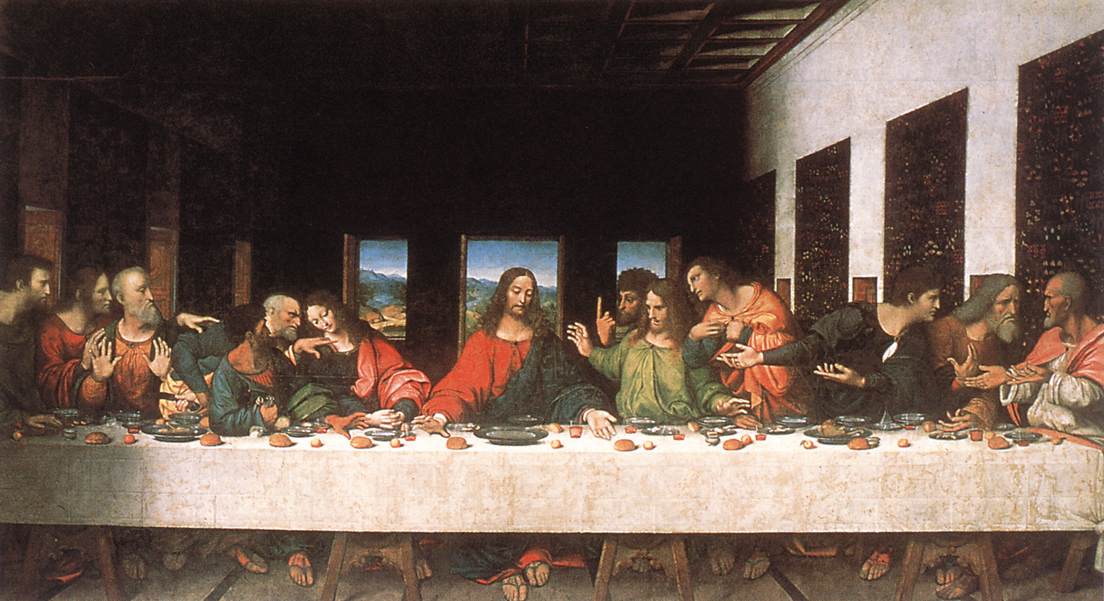
In a New York Times blog post today, Ross Douthat takes a break from lobbing accusations of corruption and conspiracy at Pope Francis to explain anew his belief that the church cannot change the way it relates to lesbians and gays, the re-married, and the polygamous. In particular, he takes issue with Fr. James Martin’s claim that Jesus’ wildly promiscuous practice of table fellowship ought to inform our approach to debates about contemporary Eucharistic comportment. Although the connection between the Last Supper and Jesus’ practice of table fellowship has been widely accepted by Catholic theologians, Douthat strongly wants to sever this link. Re-directing our attention to the Last Supper alone, he contends:
No: It’s a very specific debate about whether conversion and repentance are necessary, not for community, but for communion: The reception of the eucharist, the body and blood of Christ, during the central act of Catholic worship, the sacrifice of the mass. And by claiming — or at least very strongly implying —that Jesus’s meals with sinners are the template for how the church should think about communion, Father Martin is effectively rejecting the entire sweep of our church’s tradition on this question.
This tradition is rooted in the gospels themselves, where the Last Supper is emphatically not a feeding of the five thousand moment or a meal with a tax collector: Those encounters are arguably prefigurations of the Last Supper, but the actual eucharist itself is instituted in an intimate encounter between Jesus and his closest followers, held in a private upstairs room far from the crowds and hangers-on.
But I have some questions.
- When did the Gospels ever portray the eleven disciples gathered together at the Last Supper as sinless or particularly repentant? Did not Jesus call Peter “satan?” Did not Jesus invite Peter to this Very Important Gathering even though he knew Peter would deny him three times just a few hours later?
- More importantly, how do we know that Jesus decided to share his body and blood with those eleven because of their repentance for sins of any kind, as Douthat’s arguments against Fr. Martin imply? Put another way, where lies the evidence that Jesus considered their refraining from and repenting of sexual sin a prerequisite for their inclusion in this sacred meal?
- Douthat contends that “by claiming—or at least very strongly implying—that Jesus’s meals with sinners are the template for how the church should think about communion, Father Martin is effectively rejecting the entire sweep of our church’s tradition on this question.” But what about those earliest Christian communities that celebrated a Eucharist of fish and loaves? Are these communities that drew inspiration not from the friends-only dinner party that Jesus held before he died but from his condition-less feeding of the masses not a part of the tradition? What is the hermeneutic of tradition that Douthat employs when he seemingly casts the earliest Christians out of the tradition?
- If the Last Supper alone provides the template for Eucharistic discipline, then how can women be allowed to take Christ’s body into their own? Put another way, why does Jesus’s including only men in his inner circle evidence that women cannot be priests but not that they cannot receive the Eucharist?
Douthat, like other Catholics, exhibits a selective sacramental literalism. Certain aspects of the Lord’s Supper, such as the masculinity of the assembled guests or the literal meaning of the words Jesus spoke, possess a seemingly self-evident inviolability. It must be today, exactly, as it was then. But other elements of the feast, such as the fact that it transpired as a real meal that filled the belly rather than simply dissolving on the tongue, on the other hand, can be discarded. Bodies matter but only sometimes.
If the Last Supper alone provides the blueprint for the Eucharist as Douthat insists it does, then we must either allow women ordination or refuse them sacramental encounter with Christ’s body and blood. Indeed, the fact that the church has admitted women to this feast while denying them official ordination indicates that the church has always recognized the connection between Jesus’ wildly promiscuous practice of table fellowship and the sacrament of Eucharist, even if it has yet to realize the full implications of this understanding.


Leave a Reply