
Yesterday was an extremely exciting day for me. First, it was the last session during Exam Week of my Social Justice Ethics class. My students in that class have been partnering with students at the Universidad de Monterrey, Mexico, and yesterday they presented the research they had done with their partners in Mexico related to climate change and the environment—a topic selected because it is one of the five Critical Concerns of the Sisters of Mercy.
But second, when I came out of class and called my husband as I was walking to get lunch, he told me that there had been white smoke, and a new pope had been selected! I had expected the decision to take at least another day, so I was surprised by this news. Needless to say, for the next hour I sat in my office grading, with live coverage from the Vatican streaming on YouTube so I would know immediately who had been selected.
My two best friends—who are both academics, but not theologians—and I have been texting a lot recently about our hopes for the new pope. I did a lot of reading of news profiles of the different possibilities, but I was trying not to get particularly invested in any one particular choice. I shared on our message thread this article by Annie Selak where she argued that she was not worried about the next people undoing what Pope Francis had done “because his reforms were based not on his personal preferences but on the movement of the Holy Spirit in the church.”
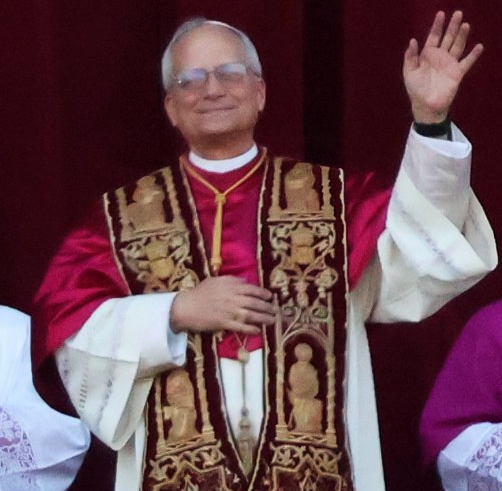
And what a movement of the Holy Spirit! I am excited about the selection of Cardinal Robert Prevost, especially in his selection of the name Leo XIV! When this was announced yesterday, I immediately sent a message to my Social Justice Ethics students—despite having seen them only about an hour earlier—to remind them of the significance of Pope Leo XIII as the “founder” of the modern tradition of Catholic social teaching with his 1891 encyclical, Rerum Novarum. If all I knew about the new pope was this choice of name, based on that alone I could firmly say that I am excited to see the writings that come out of this papacy.

Everything that I’ve read and reread in the news since the announcement of the new pope has confirmed my excitement. Heather Cox Richardson reminded me this morning that the context of Rerum Novarum was, in part, the Gilded Age, a time of extreme economic inequality. Rerum Novarum, while firmly rejecting socialism (in the sense of the state owning the means of production), reminds us that governments should take responsibility for the common good (32) and, in doing so, should pay particular attention to the needs and welfare of the poor and working class through distributive justice (33). Justice “demands that the interests of the working classes should be carefully watched over by the administration, so that they who contribute so largely to the advantage of the community may themselves share in the benefits which they create-that being housed, clothed, and bodily fit, they may find their life less hard and more endurable. It follows that whatever shall appear to prove conducive to the well-being of those who work should obtain favorable consideration” (34). And, importantly, the state should step in and intervene “whenever the general interest or any particular class suffers, or is threatened with harm, which can in no other way be met or prevented” (36). We see reflected in all this the idea of the preferential option for the poor, though Rerum Novarum doesn’t explicitly use that language. Pope Leo XIII doesn’t go as far as Pope Pius XI’s Quadragesimo Anno (1931), which says that the state should concern itself with the poor because the rich can take care of themselves, but the roots of that idea are clearly present. In this context, the choice of the name Leo seems to indicate that the new pope will have a lot to say about the growing economic inequality in today’s world, and perhaps reflects a critique of the “preferential option for the rich” reflected in President Trump’s administration.
Given the significance of Rerum Novarum as a starting point of the tradition of modern Catholic social teaching, I expect great things from Pope Leo XIV. But, as I was reminded by Ulrich Lehner’s piece in First Things today, Pope Leo XIII was not the only pope named Leo who was known for bold statements. I had been so focused on the significance of Pope Leo XIII that I hadn’t even started to consider the twelve prior Pope Leos! Pope Leo I’s 449 letter, known as the Tome of Leo, set out a description of Christ as fully divine and fully human, in which “the properties of each nature and substance were preserved in their totality, and came together to form one person” (text from McGrath’s The Christian Theology Reader). Thus, while Pope Leo XIII established the tradition of Catholic social teaching, likewise Pope Leo I contributed to our understanding of the basics of the Christian tradition as we understand it today.

I thus have high hopes for this new pope—that he will continue to emphasize the importance of mercy, human dignity, and even the care for our environment, as I had previously hoped.
Featured image from Edgar Beltrán / The Pillar, CC BY-SA 4.0, via Wikimedia Commons.


Leave a Reply